Showing posts with label Nonfiction Reading. Show all posts

6 Activities for Women's History Month Upper Elementary

6 Activities for Women's History Month Upper Elementary

When March rolls around, I love to spend time celebrating amazing and inspirational women in honor of Women’s History Month. But finding meaningful and engaging ways to weave Women’s History Month lessons and activities into your lesson plans can feel overwhelming, especially with testing season looming and spring fever beginning!


No worries! I can help!


You don’t need an elaborate lesson plan to make an impact. Simple, intentional activities can spark powerful conversations and inspire your students to learn more. Whether you have five minutes or a full lesson block, these five ideas will help you bring Women’s History Month to life in your upper elementary classroom.


How can I celebrate Women's History Month in my Upper Elementary Classroom?


1. Celebrate with a Women's History Month Bulletin Board

women's history month bulletin board posters display

Nothing says celebration like a bulletin board dedicated to amazing women! Starting the first day of March, create a bulletin board highlighting women you want your students to learn about. I love Women's History Month posters that give just the right amount of information that will ignite students' curiosity to learn more! 


The Women's History Month Posters that I share include:

✔ Woman's name

✔ Years of her life

✔ Highlights of her life

✔ Meaningful Quote


By sharing just enough information, your students will want to learn more and begin asking questions about each woman and even other influential people. Each time your students walk by your bulletin board their curiosity will grow!


💡Teacher Tip: Not enough room to hang all 20 of these posters? Just share five each week of the month. By the end of the month, you will have shared all twenty.


2. Share a Women's History Month Slide Each Day


women's history month daily slides google Powerpoint

I love the ease of having slides prepped and ready for the entire month


When making slides to celebrate women, remember to give students just enough information to spark their curiosity! I love to sprinkle in general information designed to have students ask more questions about the focus woman of the slide. I also prep a question ahead of time to discuss. This helps save time and keep our discussions focused!


Ways to bring Women's History Slides into the classroom each day:

✔ Morning Meeting

✔ Transition Time

✔ After lunch/recess

✔ Kick off Social Studies Lesson

✔ End of the Day Wrap-up/Meeting


💡Teacher Tip: Pair up your students before sharing the slide to increase engagement in the discussion and question response. This will ensure that each student has time to share with someone.


3. Read a Women's History Month Picture Book

women's history month read aloud picture books for upper elementary


While there are so many amazing, must-read books to celebrate women, I have seven go-to picture books I love reading each year! My upper elementary students have always loved these sevenread-aloud and learn so much through our interactive read-aloud and follow-up activities. These inspirational books are must-reads!


Women's History Read-aloud books for March:

Herstory: 50 Women and Girls Who Shook Up the World - by Katherine Halligan

Shaking Things Up - by Susan Hood

The Girl With a Mind for Math - by Julia Finley Mosca

Helen's Big World - by Doreen Rapport

Planting Stories - by Anika Aldamuy Denise

Counting the Stars - by Lesa Cline-Ransome

Shark Lady - by Jess Keating


Read more about each of these picture books to celebrate women and grab some fun and free activities to use with these books in this blog post HERE.


💡Teacher Tip: Invite students to find a few books that they want you to read during the month of March to celebrate Women's History Month! The kids always find amazing books in the school library and on Epic! Enlist their help and watch interest skyrocket! Don't forget to preview each book before reading to make sure they are appropriate for your specific cohort of students.


Grab the free printables to use with these books here:


4. Dive into Women's History Month Biography Reading


Women's History Month reading passages and biographies for Upper Elementary


I am always trying to squeeze in more nonfiction reading, and using nonfiction passages about Women's History is a great way to do that!

Since testing season starts to pick up in March, using high-quality reading passages with text-dependent questions and responses is a great way to check all the boxes: social studies, nonfiction reading, and test prep. Plus, the more you read about famous women, the more students' curiosity grows!

💡Teacher Tip: Short on time for Women's History reading passages? Assign one passage to each group of students. After they complete the reading and response questions as a group, invite students to share what they learn! They can simply summarize it aloud or create a quick presentation. This ensures that students are exposed to a wide variety of influential women during Women's History Month.


5. Try a Woman Focused Biography Research Project 


Women's History Month biography research projects for Upper Elementary


Women's History Month is the perfect time to dive into nonfiction and informational research writing! 

We focus on biography research projects to meet information or informative writing standards. I love to have students pick a woman of their choice to research. However, I have my students "apply" to research someone. This helps students pick historic or monumental women in history, and not someone just famous. Plus, it limits repeats, which is so important when it comes time to share their biography research project.

💡Teacher TipHead here to read my 3 Must-Do Biography Research Tips to learn my step-by-step approach that helps students succeed! 


6. Get Creative with Student-Created Women's History Month Posters

Women's History Month poster project for kids in Upper Elementary


These open-ended biography research project posters are a lifesaver! They are perfect for any biography research project and especially fun for celebrating Women's History Month. They are self-differentiating since students can add as much or as little information as you expect and assign. I love the mix of writing and illustration boxes, which is engaging for all levels of learners. These make amazing bulletin board displays for Women's History Month and the perfect addition to your studnets' writing portfolios!

💡Teacher Tip: Keep it simple! Allow students to add their own headers to the posters so that each poster is a unique project! 

The month of March is the perfect time to celebrate the achievements of inspirational women and spark meaningful discussions in your classroom. These easy to implement ideas will be a win with your students. With a mix of read-alouds, engaging posters and displays, and student-focused projects, you will excite, engage, and motivate your upper elementary students to learn as much as they can!


If you’re looking for ready-to-use resources to make planning even easier, I can help! Grab my Women’s History Month Posters, Slides, Reading Passages, and Bulletin Board Pack to bring these activities to life with no prep!


Save time, grab the Print & Go Women's History Pack!

Women's History Month bulletin board posters display for classroom and the school


                     Love these ideas? Pin to save!

6 Activities for Women's History Month Upper Elementary


*affiliate links: “Think Grow Giggle is a participant in the Amazon Services LLC Associates Program, an affiliate advertising program designed to provide a means for sites to earn advertising fees by advertising and linking to Amazon.” (source: Section 5)


signature

Teaching Text Structure: A Simple Routine for Upper Elementary

As upper elementary teachers, we are always looking for ways to help our students increase their reading comprehension skills, especially when it comes to reading nonfiction informational texts. We can help our students better understand the nonfiction passages and materials they read by helping them understand and differentiate between different text structures. 


👉 5 Text Structures Upper Elementary Students Face as Readers:

  • cause and effect
  • sequence
  • description
  • compare and contrast
  • problem and solution


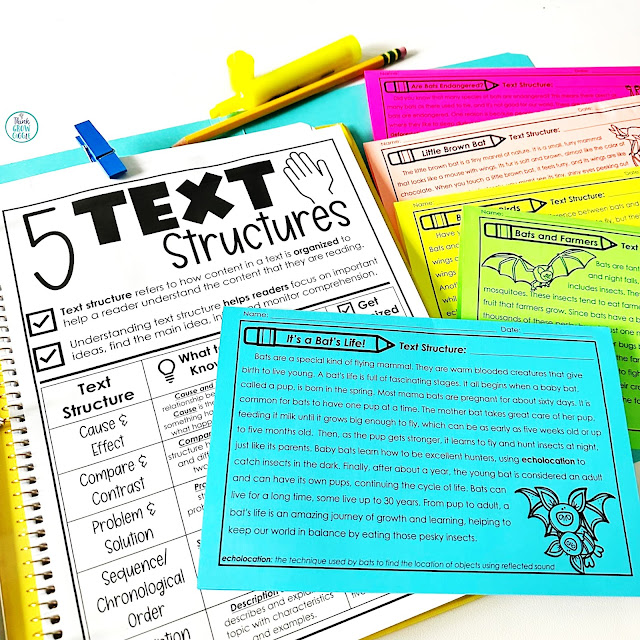
Text structure refers to how content in a text is organized to help readers understand the content they are reading. Understanding the five different text structures helps readers dive deep into the text to understand important ideas, identify the main idea, infer, and monitor comprehension.


Research tells us that understanding text structure is a guiding force for comprehension and guides students in understanding how the information is laid out, ultimately understanding the purpose of the piece. Teaching students how to differentiate between text structures empowers them with the tools to comprehend, analyze, and communicate the information they are reading effectively. It also helps them identify bias as they read more complex nonfiction texts.


How to teach text structure to upper elementary students...

1. Explain, Teach, and Give Visuals

When it comes to getting started, be sure to explain these three things: why each text structure is used, keywords that help identify each text structure, and showing/modeling with coordinating text structure graphic organizers. Spend time explaining the differences between each text structure. Create anchor charts that show these three pieces of information. Grab a free ancho chart at the bottom of this post to get started!


2. Read a Picture Book to Bring Text Structure to Life

A great way to show students different text structures is to read different picture books, at least one from each text structure. This is a great way to bring in a visual and a real-world connection to this tricky concept. Don't worry; you do not have to scour the internet to find the best text structure picture books for upper elementary, I already have a list made for you broken down by text structure!

👉 Read about my favorite text structure picture books HERE.


3. Get Into a Routine

Provide students multiple opportunities and exposure to different text structures to help them build their comprehension toolbox for nonfiction texts. One way you can do that is through daily practice. I have created a daily routine that provides students with many opportunities to read a variety of informational topics written in different text structures. It is simple to use and of high interest to students! Plus it goes beyond just practicing text structure, it also provides vocabulary, critical thinking, and written response practice.


By reading and working with all five text structures on the same topic, students can identify the different characteristics of each structure more simply. This format takes a tricky concept and makes it manageable for our students, especially when they are just learning about text structures.


This routine uses the Text Structure Comprehension Foldables. Simply print back to back and fold. Everything you need to teach and practice text structure daily is included.


Take a look at how to use these foldables to teach text structure for upper elementary students!


Try this schedule to add to your morning work routine to provide daily opportunities for your students to engage with different text structures.


If completing these text structure activities each morning is not an option, you can add these Text Structure Foldables to a center, use them during small group instruction, or sprinkle them into any time you have. Since these packs have five different passages in five different text structures, all on the same topic, students can truly differentiate between the different structures. 


Get started with teaching text structure with this FREE text structure starter kit!


The more time students spend reflecting on the text structure of nonfiction reading materials, the more they can identify the text structure in their own independent and real-world reading. By understanding the text structure, students are better able to pull out the important information, make inferences, and understand the topic at a deeper level. So why not give this routine a try today!? 


You will also love to read:

Using Reading Strategies to Help Readers Grow

Teaching Students Summarize

Quick Tip to Differentiate Summarizing Instruction 

Must Try Inferencing Lesson for Upper Elementary


Check out these Text Structure activities HERE

Like these Text Structure Foldables to just add to your daily routine!


LOVE these ideas? Pin to save!


*affiliate links: “Think Grow Giggle is a participant in the Amazon Services LLC Associates Program, an affiliate advertising program designed to provide a means for sites to earn advertising fees by advertising and linking to Amazon.” (source: Section 5)


signature

7 Solar Eclipse Activities for Upper Elementary

7 Solar Eclipse Activities for Upper Elementary


Ready for the 2024 solar eclipse in your upper elementary classroom?

When learning about phenomena, upper elementary students dive right in! Their curiosity lends itself to conversations that help them understand tricky concepts like solar and lunar eclipses. That is why I love bringing current events into the classroom!


What is a solar eclipse?

A solar eclipse occurs when the moon positions itself and passes between the sun and Earth, casting a shadow that either partially or completely conceals the sun's rays. This is considered a rare and extraordinary event because the moon does not orbit in the exact same path as the sun and Earth do.


Teaching about Solar Eclipses

Since solar eclipses are rare, bringing them into the classroom is a great way to make learning authentic and harness your students’ excitement into meaningful activities. Not sure how to get started teaching about solar eclipses? Try these ideas! From hands-on experiments to creative and art-inspired tasks, each activity is designed to not only ignite your students' curiosity but also deepen their comprehension of the upcoming solar eclipse. 


1. Read a Picture Book About the Solar Eclipse

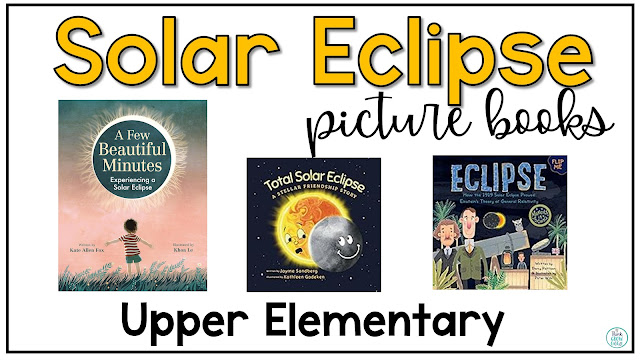
I love turning to picture books when kicking off any new unit, especially tricky science concepts! Since solar eclipses are rare, I can feel confident that the books I select to share with students will be new to them and help them visualize and see eclipses through the books' illustrations before the big event occurs! Reading picture books aloud to upper elementary students helps build background knowledge, allowing all students to have some understanding of the concept or phenomenon before our learning begins.


👉Here are three of my favorites for upper elementary...


Solar Eclipse Books for Upper Elementary
*affiliate links: “Think Grow Giggle is a participant in the Amazon Services LLC Associates Program. Purchasing does not cost extra for you and recommendations are real


2. Compare and Contrast Solar and Lunar Eclipses

Bringing nonfiction reading passages to your science lessons is a great way to connect content with informational reading skills. When I taught fifth-grade science, I saw firsthand the disconnect students had with using different nonfiction reading strategies they had learned throughout the years with science content materials they were resading. Since then, I always find ways to bring nonfiction reading skills into science class. One easy way to do that is to use informational passages to help students understand eclipses.


Want to give it a try? One way you can try using nonfiction strategies like a study of text structure during your solar eclipse study is to have students focus on comparing and contrasting solar and lunar eclipses. This one idea will have your students comparing, contrasting, critical thinking, and most importantly, understanding the differences between the two. 


💡Follow these three steps to compare solar & lunar eclipses:

  1. Read nonfiction passages about both lunar and solar eclipses.
  2. Have students interact with the text by highlighting important information about each eclipse in a different color. This will help them complete a Venn diagram easily about the two different eclipses.
  3. Sketch! Bring out the colored pencils and have students create sketch illustrations with pictures to show the difference between these eclipses. Go one step further and have students include labels and captions for their illustrations.


solar eclipse printable reading passages upper elementary kids


3. Watch a Video About Solar Eclipses to Visualize

Lunar and solar eclipses are tricky concepts!


Help your students see eclipses in action by weaving kid-friendly videos about lunar and solar eclipses into your unit. You can easily show these before any lesson, during snack, or after recess. Go one step further by having students write on sticky notes four important concepts from the videos. Collect all the students' sticky notes when the video ends and add them to a chart paper. Share the ideas that the students recorded, looking for patterns or repeated information. This will help you zoom in on the important concepts from the videos.


Try one of these lunar and solar eclipse videos:


Kindly note: As with any video you show your students please preview the video to ensure they are appropriate for your cohort of students!


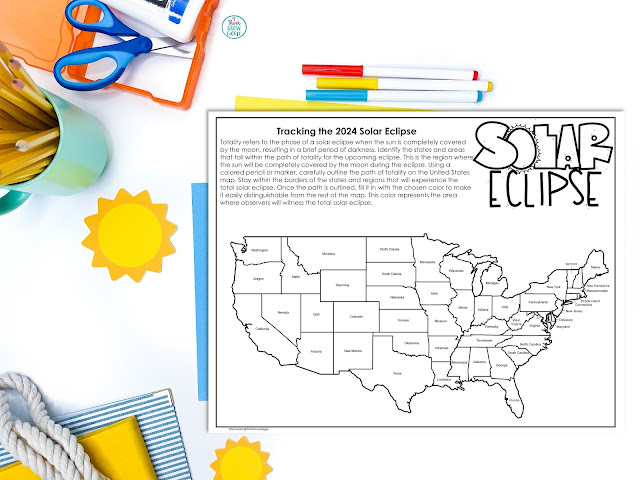
4. Map Out the Totality

Discuss the path of the 2024 eclipse using a United States map to track it, discussing its totality. Totality is a rare and captivating occurrence that occurs only in specific locations along the eclipse path.


Totality refers to the brief and spectacular phase of a solar eclipse when the moon completely covers the sun, casting a shadow on Earth and sending the immediate surroundings into darkness. During totality, the sun's bright disk is entirely covered, revealing the solar corona—a halo of hot, ionized gas surrounding the sun. This unique and awe-inspiring moment allows observers within the path of totality to witness the sun's outer atmosphere, experience a temporary twilight-like atmosphere, and marvel at the celestial alignment of the moon and the sun. 


How to dive into the totality:


map of solar eclipse free printable for upper elementary kids


Grab the FREE solar eclipse mini pack here:


5. Get Up and Moving with a Simple Experiment

What better way to explore science concepts than with hands-on science experiences! 


💡Try this idea:

Simulate the phases of a solar eclipse using the students as models. Have each group of three students color and create a sun, moon, and earth using different size paper plates. The largest paper plate is the sun, the smallest paper plate is the moon, and the middle plate is the earth. Students can use construction paper or markers to decorate each plate. Once each plate is created, have students hold them over their heads and demonstrate how the moon blocks the sun's light during the eclipse, ensuring that all three students stand in the right positions. Have them sketch how they stood to show the solar eclipse in action!


6. Solar Eclipse Writing Prompts

Learning about any topic during science certainly lends itself to writing informational pieces. Students can write informative writing pieces to show or explain what they learned, share their opinions, and explain how something works. You can also get more creative with writing projects during science. Have your students go outside the box and write and create acrostic poems, descriptive paragraphs, and narrative pieces that weave in facts they learned. 


Try some of these prompts during your solar eclipse unit, and don't forget to grab the free solar eclipse acrostic poem template and these prompts above.

  1. Imagine you are an astronaut exploring outer space. Write a journal entry about the solar eclipse you witnessed from your spaceship.
  2. Pretend you are a scientist studying the solar system. Write a report explaining why solar eclipses happen and how they affect Earth.
  3. If you could travel to the moon during a solar eclipse, what would you see and experience? Describe your lunar adventure in detail.
  4. Create a dialogue between the sun and the moon during a solar eclipse. What do they say to each other? How do they feel about this rare event?
  5. Write a free-form poem inspired by the beauty and mystery of a solar eclipse. Use descriptive language to capture the emotions and atmosphere.
  6. Draw a picture of a solar eclipse and write a short paragraph explaining the different phases. What happens during each stage?
  7. Pretend you are a news reporter covering the solar eclipse for a kids' newspaper. Write an article detailing the important facts and interesting aspects of the event.
  8. If you were a superhero with powers related to the sun and moon, how would you use them during a solar eclipse? Create a superhero comic featuring yourself as the hero.
  9. Write a persuasive essay convincing your classmates that everyone should take a break from their regular activities to observe a solar eclipse. What makes it a special and educational experience?
  10. Write a letter to an alien pen pal explaining the concept of a solar eclipse on Earth. How would you describe the event to someone from another planet?


7. Get Creative with Solar Eclipse Art Projects

I love to have students use creative thinking and their art skills to show what they learned! Wrap up your unit on the solar eclipse with one of these ideas to help synthesize their learning.


solar eclipse creative art activities 3rd 4th 5th grade


The world of solar eclipses is fascinating and mysterious, especially for our upper elementary students!  Whether your students are aspiring astronauts, budding scientists, or someone who loves a good adventure, witnessing a solar eclipse is a memorable experience and one we should support as educators. Add different hands-on activities, art-inspired tasks, and outside-of-the-box writing projects to your solar eclipse lesson plans to help inspire students! Mark your calendars for the April 2024 eclipse, try some of these activities, and watch your students be inspired to learn as much as possible!


Happy teaching! : )


You will also love reading:


Check out these solar eclipse activities HERE.


solar eclipse reading passages lesson ideas 3rd 4th 5th grade


LOVE these ideas? Pin to save!


teaching solar eclipse for 3rd 4th 5th graders


*affiliate links: “Think Grow Giggle is a participant in the Amazon Services LLC Associates Program, an affiliate advertising program designed to provide a means for sites to earn advertising fees by advertising and linking to Amazon.” (source: Section 5)


signature

Teaching Text Structure Upper Elementary

Teaching Text Structure Upper Elementary


When it comes to reading nonfiction material, students can never get enough practice! While many students enjoy reading nonfiction and informational articles, they often focus on the cool or new facts they learn. While that is a great way to get students engaged and excited to read nonfiction, we must ensure our upper elementary students are diving deep into the structure of informational text to help build their comprehension skills.


What is Text Structure?

Text structures refer to the way authors organize information in a text. Mastery of these structures allows students to comprehend and analyze nonfiction texts more effectively and deeply. The five key text structures our upper elementary students face are cause and effect, description, sequence, compare and contrast, and problem-solution.

Understanding text structures matters! Research shows that understanding text structure is a guiding force for comprehension. According to findings from educational psychologists (e.g., Pressley & Afflerbach, 1995), explicit instruction on text structure significantly enhances students' ability to grasp the relationships between ideas and the overall comprehension of the text. It is like providing students with a roadmap showing them the way to understand the nonfiction text that they are reading.


Why Teach Text Structure?

There are so many benefits that come along with understanding text structure as readers. When you engage your students in nonfiction studies focused on understanding text structure, you will see...


Enhanced comprehension - Understanding text structures helps students make sense of information by recognizing patterns and relationships between ideas.

Improved critical thinking -  Analyzing different text structures encourages critical thinking as students learn to evaluate and compare information in various ways.

✅ Increase in communication skills - Mastery of text structures supports students in expressing ideas clearly, both in writing and verbal communication.

Sharpened skills for success -  Proficiency in text structure is a foundational skill that prepares students for more complex reading and writing tasks in higher grades.

Real-world Application -  Recognizing text structures is not just an academic skill; it is a practical skill that students will use in different aspects of their lives, from reading news articles to understanding procedural manuals.


How to Teach Text Structure

Teaching nonfiction text structures is an important step in developing strong reading comprehension skills in upper elementary students. Try these go-to ideas for teaching text structure in your upper elementary classroom!


1.  Teach Each Text Structure in Isolation

Use anchor charts and a slideshow to help teach this tricky concept! Begin by introducing each text structure separately. This ensures that students grasp the unique characteristics of each before moving on to more complex tasks and critical thinking about text s. Three things to make sure that you include in your anchor charts and introductions are:


✅Why each text structure is used

✅ Keywords that signal each text structure

✅ A visual {graphic organizer} to connect to each text structure


Teaching Text Structure Anchor  Charts for Teachers


Grab the FREE Text Structure Starter Kit right here!


💡Teacher tip: Use pre-written passages on the same topic, each with a different text structure! I love to use these that are focused on natural disasters!


The passages hold the students' attention and clearly show how each text structure differs. I use a slide show to share the passages, and students determine which text structure it is. Once we agree, we head to the next slide to find the answer reveal and work together to prove it by completing the graphic organizer on the next slide.


love that this slideshow not only helps my teaching and introduction of text structures but is also a great tool to refer back to throughout the year and before testing season begins!


Teaching Text Structure Upper Elementary and middle school


2. Utilize Graphic Organizers as Readers and Writers

Using visual aids like graphic organizers is a great way to help students organize information and visually differentiate between the different text structures. These tools provide a clear visual representation of how information is structured in a text and helps them collect important information. When students complete the graphic organizer about a specific text, they are collecting information that will help them prove which text structure they are reading. Doing this helps them better communicate with others about their reading and convey the author's purpose and message.


Teaching Text Structure Graphic Organizers


3. Read Multiple Texts on the Same Topic

To deepen understanding, have students read five short texts on the same topic, each utilizing a different text structure. This activity enables them to compare and contrast how information is presented and identify the distinctive features of each structure. Students will collect a lot of information about one topic and show students that the longer informational books and passages they read can have more than one text structure within them.


💡Teacher Tip: Go one step further and have students respond to a prompt and write about what they learned about the given topic to synthesize their learning!


Teaching Text Structure Reading Passages Nonfiction


4. Real-World Sorting Activity

This is a fun way to kick off a text structure unit or wrap one up


Encourage students to collect reading materials from the real world, such as newspaper articles, brochures, directions, ads, informational pamphlets, and really anything! I always have a stash ready to show students how to sort the reading material. I use hula hoops to sort each text structure, but you can use chart paper or just a table to group the reading materials. The concept is simple, just label each hula hoop with each text structure. Then, share reading material like directions to a game. Have students decide which text structure it was written in through discussion and debate. Then, select a student to put the directions read into the matching hula hoop! This hands-on activity connects classroom learning with real-world reading, and the kids love it!


5. Create Collaborative Projects

Foster collaborative learning by assigning projects where students work together to create a presentation or report using a specific text structure. This not only reinforces individual understanding but also promotes teamwork and communication skills. We have done collaborative class projects for text structure on one topic, such as Earth Day. Each group was assigned a text structure. Then, they worked together to develop a presentation for the class on an Earth Day-related topic in the assigned structure. 


Here is what the kids came up with: 

  • Compare and Contrast: Solar Energy VS Electricity
  • Sequence Order: The Process of Recycling
  • Description: Enjoy Visiting a National Park on Earth Day
  • Problem and Solution: Reduce, Reuse, Recycle
  • Cause and Effect: Save the Mountain Gorillas from Extinction


Teaching nonfiction text structures is a fundamental step in developing strong reading and comprehension skills in upper elementary students. By focusing on cause and effect, description, sequence, compare and contrast, and problem-solution structures, we can help strengthen our students' understanding of informational texts. Implementing these tips will make the learning process engaging and empower students with essential skills for academic and real-world success. Plus, research shows that understanding text structure helps students succeed as readers of nonfiction texts, so get started with some of these ideas today!


You will also love to read:
Using Reading Strategies to Help Readers Grow

Nonfiction Teaching Ideas and Strategies to Hook Upper Elementary Readers

Must Try Inferencing Lesson for Upper Elementary


Check out my favorite Text Structure activities HERE

Like these Text Structure Foldables to just add to your daily routine!


Teaching Nonfiction Text Structure 3rd 4th 5th Grade


LOVE these ideas? Pin to save!


Teaching Text Structure ideas for Teachers


*affiliate links: “Think Grow Giggle is a participant in the Amazon Services LLC Associates Program, an affiliate advertising program designed to provide a means for sites to earn advertising fees by advertising and linking to Amazon.” (source: Section 5)


signature

Quick Tip to Strengthen Reading Comprehension Strategies for Upper Elementary

Quick Tip to Strengthen Reading Comprehension in the Upper Elementary Classroom

Multiple-choice questions are not my thing.


Before Connecticut shifted to SBAC testing, teachers wrote the yearly state exams. I was on a team that wrote 3rd-grade reading tests. This included the passages and the questions. So much professional development and non-disclosure agreements went into the multi-day training we were provided to be certified to write those exams. 

The entire process was extremely eye-opening and helped me learn a lot about what makes a good and fair assessment for students. After all that training, I stopped using multiple-choice questions to assess students in my classroom.

There is a time and place for multiple choice questions. But on a daily basis, when we read stories and passages, I do not use multiple-choice questions as a form of assessment. 

If you have any of the reading packs from my shop, you know that there are no multiple-choice questions. In fact, I often get asked why there are no multiple-choice questions...well, it is just not something I put a lot of value into when assessing students.

Multiple choice for test prep? Absolutely! I do use multiple choice questions for test prep so that students know good test-taking strategies, but I do not like to use them with daily reading activities. There are better options to use as teachers to get a pulse of students' understanding of what was read. The more you say no to multiple-choice, and yes to open ended tasks you give students as they read, the less test prep you will need to do! This is because the students have learned how to think as they read and develop good reading habits.


active reading tip for 3rd 4th 5th graders


I do not like using multiple-choice questions because...

👎 they try to measure too many objectives or not the right objectives in each question stem
👎 negatives in the question stem and "funny" choice options confuse students
👎 it is a guessing game that does not tell me if students know the correct answer or guessed the correct answer

Instead, I use...

👍 specific tasks that have students highlighting the answer in the text
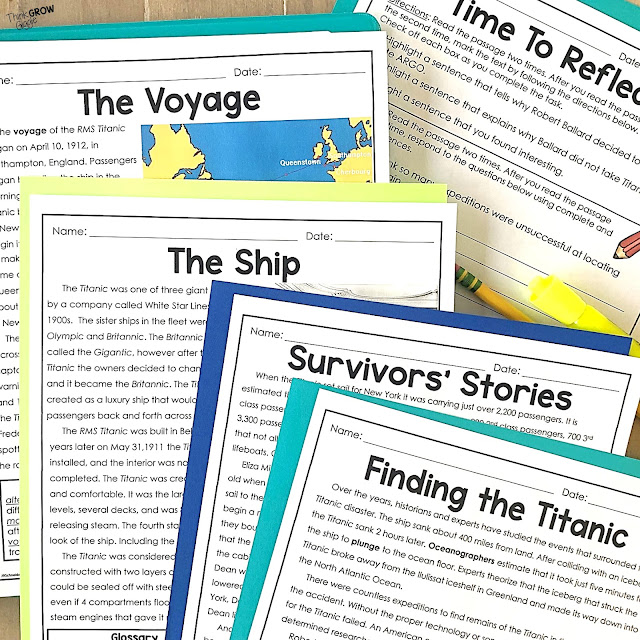
👍 short answer and open-ended response questions that value text evidence and student-reflective opinions
👍 classroom discussions around multiple-choice style questions without the choices. 


reading annotation guide for 3rd 4th 5th graders


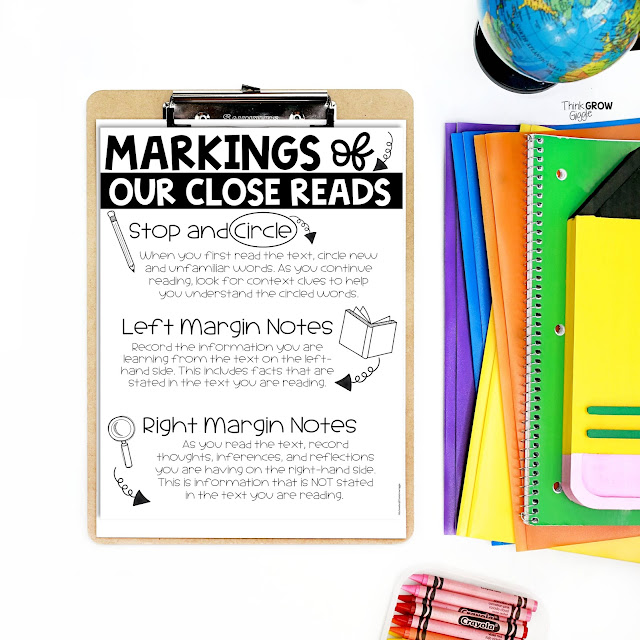
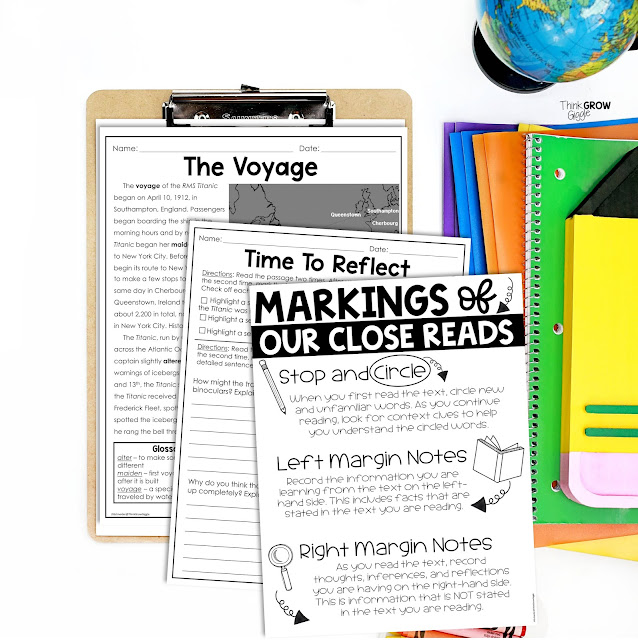
If you want to begin to shift away from using multiple choice questions, try these simple annotation tips to get started. These tips can be used with any text and no fancy tools or resources are needed. 

Simply write these annotation tasks at the board and have students work!

Circle a new vocabulary word you learned and write your own meaning in the margin.
Underline a part of the text you found interesting and want to share with the class. 
Highlight a part of the text that made you ask a question. Write the question in the margin and a possible answer.

By encouraging students to be active readers who engage with the materials that they read rather than have them focus on picking (or guessing) an answer in a multiple choice question, their reading comprehension will strengthen. 

You can get started today using ANY book, poem, or passage that you have on hand. Simply teach students how to annotate using the suggestions above or your own, and watch them become more engaged and develop their comprehension.

Grab the FREE annotation chart and reading passage below to get started!


Looking for more reading comprehension passages and activities? Look HERE!

active reading tip using nonfiction reading passages


             Love these ideas? Pin to save them!

Quick Tip to Strengthen Reading Comprehension in the Upper Elementary Classroom


signature
Back to Top