Showing posts with label Mini Lesson. Show all posts

3 Tips For Successful Reading Conferences


reading workshop conferences


Conducting reading conferences with your students is an important part of reading workshop. 

A teacher-student reading conference takes place during independent reading time within your reading workshop block.  During this quick one-on-one meeting time, the teacher listens to the student read, they discuss the book that they are reading through discourse about the reading strategies that the student is using, and the teacher compliments the reader and gives them a suggestion or tip to use as they continue to read. 

By conferring with your students you are giving them one-on-one time devoted solely to improving their individual reading skills. It is reading differentiation at its best! Reading conferences allow students to get tailor-made individualized mini-lessons suited just for them!


It is important to make the most of the time that you have for your reading conferences. This will ensure that the student you are conferring with gets reading strategy work that will help them get stronger as a reader. Grab a reading workshop kit for FREE below.


Here are some ways that I have found that work for me to make the most of your individual reading conference time.


Be Organized
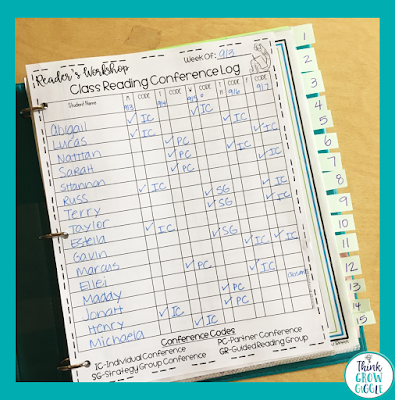

reading workshop conferencesPlanning for reading conferences can be challenging. Students that you planned on meeting with might be absent during your reading time, your mini-lesson may run over time, and students you thought were ready to work alone, may need a little extra support to help get started independently. All of these interferences cut into your reading conference time, meaning you will not meet with as many students as you had planned. My goal is to always meet with about five students each day. This ensures that by the end of the week I would have met with all of my students at least one time. 

To help me stay organized, I keep a reading conference log right at the front of my binder. It is completely organized to keep track of the conferences that I have had and which type of conference it was. Although traditional reading conferences are between the teacher and one student, I also utilize partner conferences and strategy group conferences as teacher conferring opportunities. These type of conferences do not occur as often, but there are days that students work together on reading tasks, so when I meet with them as a pair, we all confer together! I also mark this sheet with information that will help me keep track of student growth such as absences or when a student is pulled out of my classroom for additional services. This page serves as a great tracking system! This sheet is also helpful for planning. Before reading workshop begins, I can quickly look at this page and know which students I will need to confer with that day.


Be Prepared


reading workshop conferencesHaving a reading conference toolbox is a great way to be prepared for all of your reading conferences. 

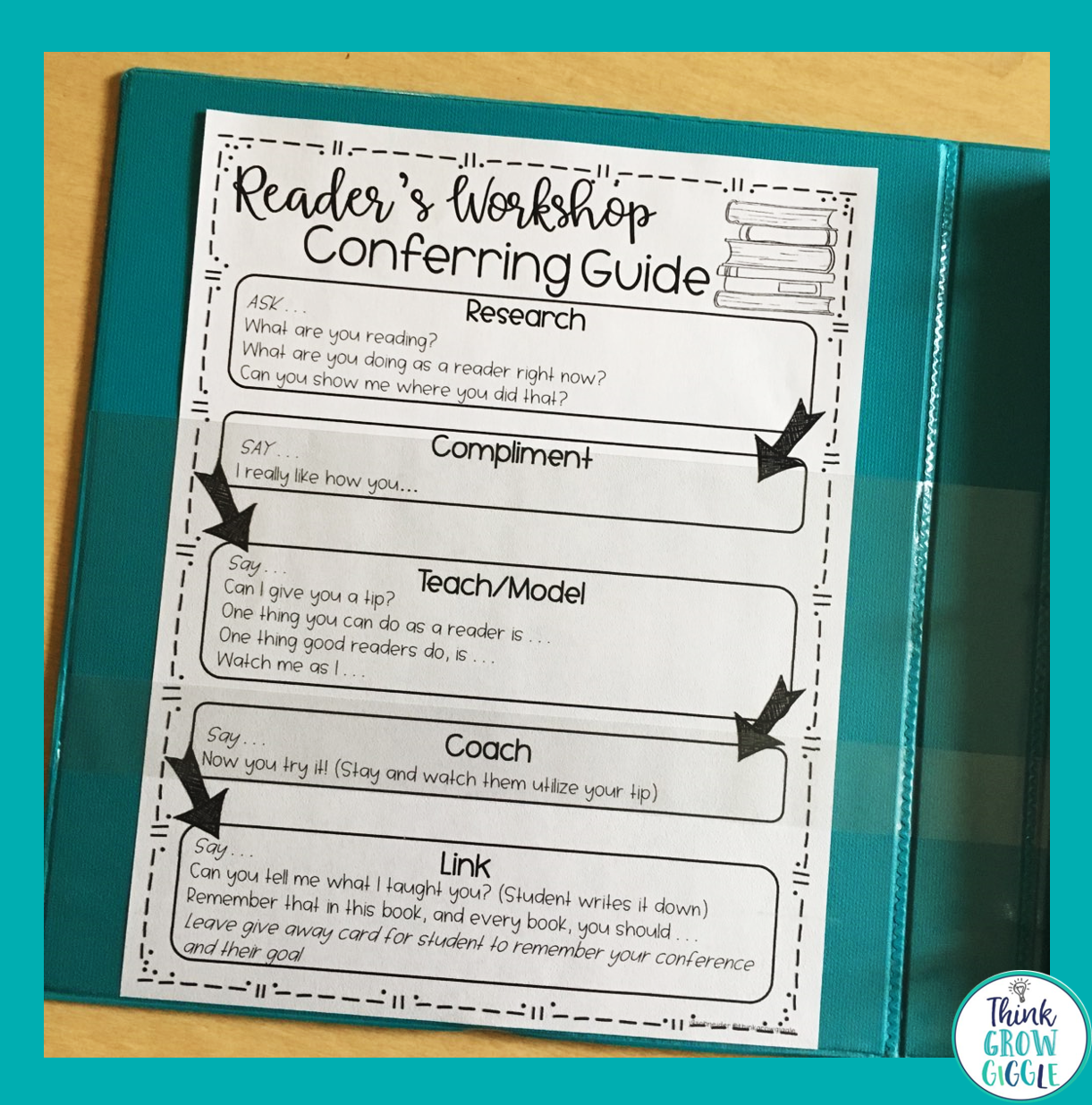
Inside my reading toolbox are the essentials that I need to meet with each student for their reading conference. It contains a reading workshop conferring guide to keep me on track, a previously read picture book from the current unit of study, so that we can refer back to it together to review strategy work, conference datasheets for me to take notes on, reader take away cards so that I can leave the students with a handwritten compliment and suggestion,  and of course pencils, highlighters, pens, and sticky notes!

Having student data sheets are a must! The more detailed notes you take during the conferences, the better you are able to help each student as an individual. You can use a plain notebook and take detailed notes, making sure to note the student's name, date, and book that they are reading, or you can use very detailed note sheets to track reading fluency, include strategies, and your entire discussion. Both work well, so pick the style that works for your! Just be sure to keep track of each and every conference that you hold with each student. 


Be Positive


reading workshop conferencesAlways, always, start your reading conferences off with a positive vibe, to ensure that the students are excited to see you approach them for a reading conference. When you first get next to your student for a conference be sure to give them a compliment about what they are doing. Some suggestions for compliments could include student organization, the student getting lost in the book, student taking notes, student use of reading strategies, or student fluency after you listen to them read. The more positive and celebratory that you are, the more the student will continue to do what you celebrated as they read independently. Be sure to always mix up your compliments each time you meet with a student.


Be Present: Leave Your Voice Behind


reading workshop conferences

reading workshop conferences


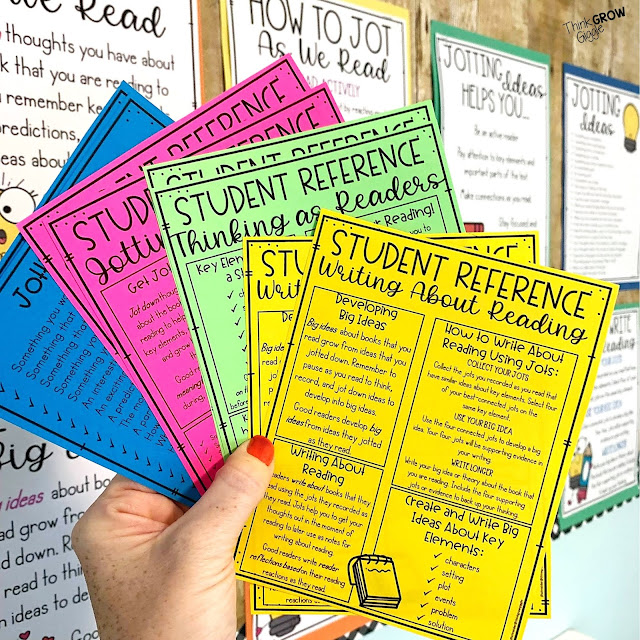
I love using these reader take away cards to help students stay on track while they independently read. I use them in two different ways. 

The first way I use them is during our reading conference. I will take quick notes on each card as we speak, including a compliment and a suggestion. When I leave, the reader gets to keep this card. They can use it as a bookmark, keep it in their reading folder, or staple it to their reading notebook page. When students forget their focus or goal, they can take out the card and remember our conversation during our conference and “hear” my voice once again coaching them along. 

I also use these reader cards on days that I did not meet with a student to confer, especially if a few days have passed. I will collect student notebooks or activity pages and correct it, and fill out a reader card with a compliment and suggestion just as if we were having a conference. When the student’s work is returned, they will see the reading card and know exactly what they are doing well and what they need to focus on as they continue to read. These cards are a great way to keep track of your conferences, too! 


Reading conferences are a powerful tool to help your students grow as readers, but they must be planned and purposeful, just like all of the other elements of reading workshopThese tips and strategies will help you to make the most of the time you have to confer with your students. 

If you are looking for more tips, check out the professional reading book: Conferring with Readers. I love this book and refer to it often! It is a great professional read to help you understand the ins and outs of reading conferences.


*affiliate links: “Think Grow Giggle is a participant in the Amazon Services LLC Associates Program, an affiliate advertising program designed to provide a means for sites to earn advertising fees by advertising and linking to Amazon.” (source: Section 5)



270


signature

6 Tips to Keep Your Mini-Lessons Mini

mini lesson strategies


The reading workshop model is highly effective to help students grow as readers. 


The first part of the workshop model is the mini-lesson. 


The mini-lesson is the time that you teach your students a specific strategy or skill that you want them to carry over into their own independent reading. It should be no more than 5-10 minutes. It is important to stick to this time limit since the biggest chunk of your reading workshop time is having your students read independently. For me, the hardest part of the mini-lesson is keeping it mini! 


Here are some strategies that I have found to be successful to keep my mini-lessons within ten minutes.


Use a Timer

readers workshop tips


Grab a timer and set it for eight minutes.  When it goes off, you know that you have to wrap up your mini-lesson. This gives you the opportunity to finish up what you are teaching or squeeze in a part from your lesson you did not address yet. 


You can use a large visual timer, a small timer on your smartboard, or an old finished wind-up timer. Anything works! After a week or two, you will start to get a feel for what ten minutes feels like while teaching and you will soon begin to finish right when the timer goes off! Don't worry about keeping the timer out of view from your students. Include them in your mission to keep your mini-lesson mini. By helping them become aware of the time restraints, they will understand when student talk time is kept to a minimum.  Click HERE* for the timer that keeps me in check.


Use a Guide 


reader's workshop forms for upper elementary


When I first started using a reading workshop modeled, I kept a mini-lesson planning template on a clipboard behind my chart paper stand. It is a great visual for me to help me move through each of the steps of the mini-lesson in a timely manner. You can also fill in the template with what you want to say and have the students do to maximize your mini-lesson time. The time it takes to plan out each part of the mini-lesson is worth it to help keep you on track for the short ten minutes that you have to teach!  Grab a copy of the mini-lesson template I use for FREE below.


Pre-write on Anchor Charts


readers workshop anchor charts


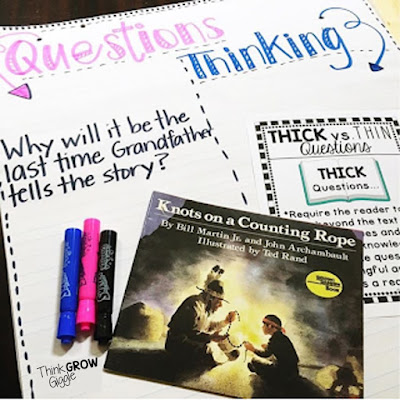
Anchor charts are a great way to remind the students the steps of different reading strategies that you teach them. 

My room is always covered with anchor charts! To save time during your mini-lesson, be sure to pre-write some of the information on your anchor charts like the headers and subheadings. Anchor charts should be interactive so be sure to leave space to record student ideas whenever possible. By creating anchor charts ahead of time, you will not only save time during your mini-lesson, but you will be creating a lesson guide to follow, too! Grab a reading workshop bulletin board banner set for FREE below.


Break Out of Your Reading Corner


Another way that I shave some time off of my mini-lesson is to take a break from teaching in my reading corner. By bringing our mini-lesson right in front of our smartboard, I am able to prepare all of my slides ahead of time and use each slide as a guide to move through the mini-lesson quickly and efficiently. The smartboard slides work as a prewritten script to keep you right on track! You can type out the teaching point, information you want to share with students, and leave blank slides to record student ideas. Working by the smartboard is especially time-saving for topics that require a longer mini-lesson like the introduction or closing lesson to a new unit.


Read Ahead of Time and Re-purpose Past Reading


launching readers workshop upper elementary


This is a HUGE time saver. 


Read your mentor texts at a different time during the day and then refer back to them, or simply reread a specific page or passage during your mini-lesson. I have found that reading aloud during odd times during the day like snack and ten-minute windows between lunch and specials is a great way to get all of my mentor texts read with my students. Look at your schedule and see where you can squeeze in some read-aloud time. Even just ten minutes somewhere else during the day will keep your mini-lesson mini!


My favorite corner of my classroom library is the corner with my previously read basket. This basket holds all the books and mentor texts that we have read aloud throughout the year. It is a great reference spot for both myself and my students. For me, it is a great spot to grab a book that we have already read and discussed for a previously taught reading strategy, that can be revisited with different reading lenses. One great book that works as a mentor text for many different reading strategies and skills is The Raft written by Jim LaMarche. This book is great to teach everything! (Grab it HERE) Character traits, how characters change, symbolism, visualization, making inferences, and so much more! 


By repurposing books, you save the time needed to read, discuss and digest new stories. Our previously read basked is a place that I often find my students visiting, too. They enjoy rereading books that we have already read to grasp a deeper understanding. This basket is especially great for struggling and reluctant readers since they are already familiar with the storyline in these previously read books.


When it comes to keeping your mini-lesson, mini, these tips will do the trick! Keeping your mini-lessons short will allow your students more time to read independently, which is the ultimate goal of reading workshop


Check out my favorite reading workshop resources HERE

Like these must-have Just Right Books pack!


just right books for kids


LOVE these ideas? Pin to save!


launching reading workshop upper grades


*affiliate links: “Think Grow Giggle is a participant in the Amazon Services LLC Associates Program, an affiliate advertising program designed to provide a means for sites to earn advertising fees by advertising and linking to Amazon.” (source: Section 5)


signature

3 Important Parts to Plan for Reading Workshop

 
launching reader's workshop upper elementary


Reading instruction is a true highlight of my day! 

I love everything about reading time in my classroom. I love reading aloud to my students, teaching reading strategies, talking about books, and of course bringing what we do during reading workshop into content areas. 

I have always loved to teach reading, but my love grew even stronger after attending the Reading Workshop Summer Institute at Teacher’s College with Lucy Calkins. This week-long seminar helped me develop and maintain a structured workshop model in my classroom and create an atmosphere to help my students develop a deep love and excitement for reading.  The best part was that I was able to take what I learned and make it my own to work for me and my students' needs.

The first year of implementing this structure during our reading block I saw a huge increase in student engagement during reading. Students strengthened their reading comprehension skills and written responses to texts. They were also highly engaged in serious and meaningful discourse about the books that they were reading. Reading became the time that we all looked forward to each day!


Reading Workshop reading format follows a specific schedule within a given block of time. It begins with a short mini-lesson and is followed by a large chunk of time for students to independently read and apply reading strategies that they have been taught. Reading Workshop time wraps up with a short sharing session. Since independent reading time is the most critical part of this block, it should make up the largest portion of your reading time. Smack in the middle of independent reading is a mid-workshop break, my students' favorite part of reading!


When I plan and prepare lessons for reading workshop, I think about what I call the 3 Ts: TEACH, TRY, & TALK: 
  • What do I want to teach? 
  • What do I want my students to try? 
  • What do I want to hear students talking about in their reading discussions? 
I consider these three components the most important part of planning for reading workshop lessons. Planning out each of these carefully allows me to maximize the time we have during reading. I carefully select and plan mentor texts, independent tasks, and partnership activities to complement the teaching point so that all three of these Ts are interwoven and students move throughout the reading block seamlessly.


# 1 TEACH


reader's workshop forms and planning


Thinking about what you want to teach for any lesson is an important part of the planning process, but it is especially important when planning a reading lesson for reading workshop

Your objective needs to be concise as the mini-lesson portion of the reading workshop is only 5-10 minutes long. One way to approach planning your objectives is to use the umbrella strategy.  To do this, begin with a specific reading strategy you want to teach and list the different lessons within each.  Each lesson idea becomes a day's teaching point

For example, summarizing is too broad to teach in one mini-lesson. Break apart summarizing into five chunks and teach one idea each day. This will ensure that you stick to the 10 minutes allotted for your mini-lesson and have a clear and concise teaching point for each day's lesson. This also allows time for students to learn and practice the skills needed to summarize over a week's time and allows you to scaffold as you teach each skill. Grab an umbrella planning organizer for FREE below.


#2 TRY


launching readers workshop upper elementary


What I love most about the workshop model is that it allows so much time for students to try out and practice different reading strategies each day; both the strategies they are learning in the current unit of study, as well as strategies they have previously learned that still apply to their current reading. 

During one day's reading lesson, I plan for multiple opportunities for students to try out the strategy taught during the mini-lesson. Students will try it during the mini-lesson, while independently reading and during our reading conferences. You can plan for students to complete a task or assignment, think graphic organizertake notes, think jotting, or you can create scaffolding questions to help each student along in their understanding, think small group work or reading conferences. No matter what tasks you assign, planning to support students as they try it out and practice multiple times in one day is critical for student success.  


#3 TALK


reading question stems and discussion starters


 Good readers talk about the texts that they read, and good teachers plan many opportunities for students to talk about what they are reading. 

Create an anchor chart of your book talk expectations and create a small paper copy for students to keep in their reading notebook as a reference. To help prepare opportunities for students to talk during the lesson, create questions or statements that you want them to discuss and debate. This is especially helpful during the mid-workshop break to keep your students on task. Each day, students should be discussing the books that they are reading and the reading strategies they are using multiple times. Student discussions take place during the mini-lesson, the teacher-student reading conference, the mid-workshop break, and at the end of reading workshop during share time. 

Talking about texts takes a lot of practice. I spend much of the beginning of the year practicing and rehearsing how to talk about books and using discussion starters to help keep the dialogue about books "going".  The discussion stems we use are designed to help students engage in meaningful discourse using their critical thinking skills. These discussion starters go beyond just summarizing or restating a part of the text. By creating an anchor chart and student reference sheet of discussion starters your students will be expert book talkers in no time! Grab discussion starters  for FREE below.


When you sit to plan each lesson during reading workshop, don't just plan the teaching point. Remember the three Ts. Plan what you will TEACH, what you want students to TRY and many opportunities for students to TALK about the strategies they are using. These expectations show your students that you value what they think and have to say about the books that they are reading.


If you are getting ready to implement reading workshop in your classroom, you might be interested in this resource to help you kick off your school year! 


launching readers workshop upper elementary


You might be interested in reading:


Check out my favorite reading workshop activities HERE


reader's workshop anchor charts


LOVE these ideas? Pin to save!


3 Important Parts to Plan for Reading Workshop


signature
Back to Top