Showing posts with label Grammar Lesson. Show all posts

Teaching Grammar with Picture Books for Upper Elementary

Teaching Grammar with Picture Books for Upper Elementary


Ahh, grammar. The never-ending list of rules we need to make interesting enough to be engaging, AND find the time to make sure we get it into our daily schedule!


Luckily, there is a multitude of amazing picture books to reinforce these grammar rules, engage students, and help us make sure we are addressing important grammar skills each week. There really is no better way to introduce, teach, and review important grammar skills than with an engaging picture book.


While you can read just about any picture book and pull out mentor sentences and examples of grammar rules in action, the following picture books are must-reads for any upper elementary classroom when focusing on specific grammar rules.


1. The King Who Rained: written by Fred Gwynn
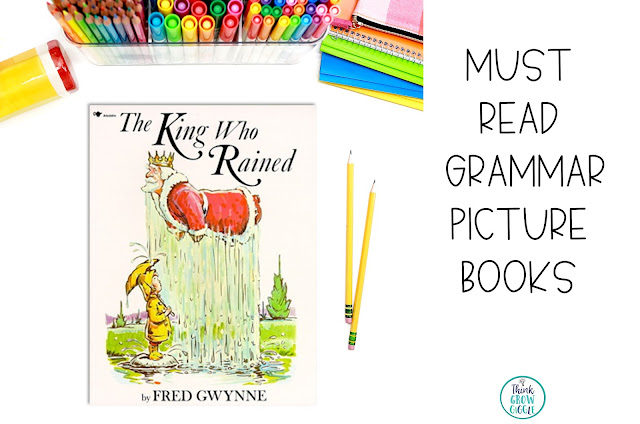

picture book for homophones


Although it’s a little older (I read this back in elementary school as a student) it is one of my favorites. The illustrations are perfect for creating a visual understanding of homophones and homonyms.  Challenge the kids to come up with their own hilarious “daddy says” homophone, and put them together in a class book to enjoy. The illustrations truly make the book memorable, solidifying this tricky concept for students.


2. Cows Can’t Jump: written by Dave Reisman
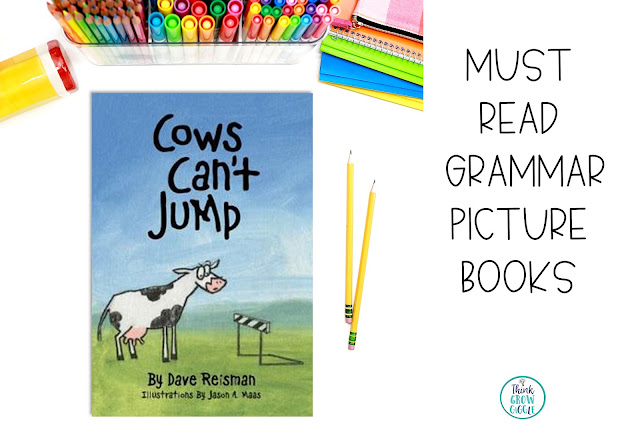

picture book for teaching verbs


In this simple book, readers are introduced to a wide array of very diverse and richly dynamic verbs. Verbs like “saunter” and “slink” can spark great conversations about how vivid verbs can transform students' writing pieces.  The class will enjoy defining (even acting out) these interesting verbs. A read-aloud of this book can be expanded into a research project to determine if these facts are true or not true about each animal.


3. Chicken In the City: written by Maria Fleming
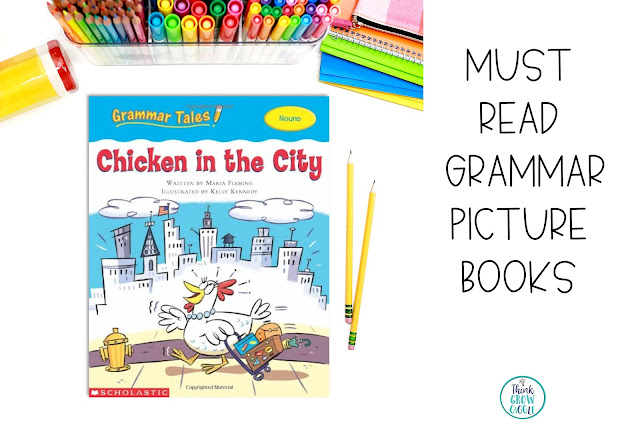

picture book for teaching nouns


There is no shortage of cuteness in this book, and that is only one of the reasons I love it! The idea of a chicken throwing her corn kernels in a suitcase, grabbing her pearl necklace, and heading to the big city just makes me giggle a little every time. This book is great for so many reasons, but it is the perfect noun resource. Some of the pages are explicitly labeled with nouns. Another reason it shines and has to be on the top grammar picture book list is that there is a change of setting. You see the array of farm nouns, and then she heads to the city and there are nouns there too. This opens the door for a great compare and contrast opportunity. Make it extra fun by turning the circles of your Venn diagram into oval eggs! Or keep it simple and have your students create a list of nouns that they see in their classroom or at home!


picture book for teaching collective nouns

Once that basic noun knowledge has been activated, there are some books that are perfect for diving into the different categories of nouns. When you want to talk about collective nouns, this is a go-to book. It’s engaging in that it introduces students to animal groups they may not be familiar with, and who doesn't love hearing new animal facts? Extend this book read by having students name their family as a collective noun. A _____ of Smith’s, Wilson’s, Brown’s, etc. Go one step further and have them explain and defend the collective noun they choose to use.


Try these free and engaging noun activities to help you get in grammar this year!


5. Pig, Pigger, Piggest: written by Rick Walton


picture book for teaching superlative adjectives

Adjectives are one of the most colorful grammar units to teach, and when you specify with superlatives, it can be even more fun! The illustrations alone are worth this read- the three pig brothers make me laugh every time I look through it. As you read this book, guide students to describe the pigs in great detail, emphasizing that superlative detail in the Piggest Pig of all. Extending this with a simple art project is so much fun! Have students draw three circles with three objects. In each circle, have your students draw a picture of objects to match a given superlative set of adjectives: small, smaller, smallest or try yummy, yummier, yummiest. Students love this activity and get more creative with each illustration. 


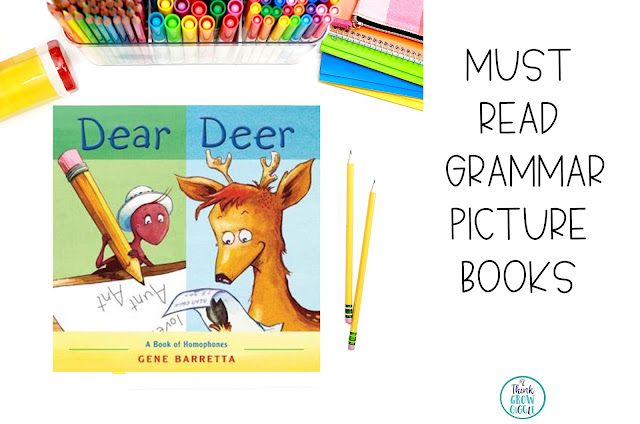
6. Dear Deerwritten by Gene Barretta


homophone read aloud for grammar lesson
This book is another one that focuses on homohones in a fun and simple way. Each page has one sentence, but that is all it takes to help students understand the different meanings of words that sound the same. Brainstorm lists of more homophones have students create their own page to add to this book. 


7. Hairy, Scary, Ordinary: What is an Adjective: written by Brian P. Cleary


adjective picture book read aloud


This book is a fun read and truly breaks down the concept that adjectives can describe how many, what kind, and how big something can be. Since adjectives describe nouns, review the concept of nouns as you read aloud this book. Create an anchor chart sized T-chart. On one side label it adjective and on the other side label it noun. As you come across an adjective, ask the students what noun it describes. Keep track of all of them in the book. This will lay the important ground work for your unit on adverbs and how they describe verbs.


8. Eats, Shoots, and Leaveswritten by Lynne Truss


picture book for teaching commas


Comma usage is always so tricky for students! This read-aloud will help your students understand the why commas are so important to use as writers. The author writes two different sentences, one with a comma and one without. The illustrations truly help the students see how different the meaning of the sentence becomes when you forget to use that comma! This book will help to make teaching students how to use commas correctly an important part of your punctuation and grammar lessons!


9. Semicolons, Cupcakes, and Cucumbers: written by Steve Newberry


picture book for teaching punctuation


This fun read-aloud follows different punctuation marks as they have a conversation showing off how they work! I love that commas and semicolons are included in this book. As you read this book, be sure to change your voice and expression to match each punctuation mark, to truly help students see how punctuation is not only important to them as writers, but also as readers. Invite students up to help you "act out" this read-aloud, taking on the role of the different punction marks. Grab a free activity to use with this book right HERE


Add these books to your grammar units for instant engagement and memorable lessons for your students! You will find that by using grammar skill-specific and focused picture books students will understand the skills better and independently apply the strategies they learned to their own writing.


Looking for more meaningful grammar activities for your students? Try these!


grammar activities for upper elementary


Love these ideas? Pin to save them!


Teaching Grammar with Picture Books for Upper Elementary


*affiliate links: “Think Grow Giggle is a participant in the Amazon Services LLC Associates Program, an affiliate advertising program designed to provide a means for sites to earn advertising fees by advertising and linking to Amazon.” (source: Section 5)


signature

3 Ways to Infuse Grammar in the Classroom


We have a lot on our plates as classroom teachers. From teaching academics to social emotional development, each minute of our day is jam packed. Unfortunately, because of this, many times something has to be cut out of our day. Many times grammar lessons are the first thing to go! BUT....grammar instruction does not have to be removed from your day. It is very easy to seamlessly infuse grammar lessons into activities that you are already doing!

Morning Meeting and Morning Message

grammar, grammar skills checklist, grammar freebie, grammar free, third grade, fourth gradeMorning message, white board message, note to students, however you begin your day, be sure to tie in some grammar practice.  Some teachers write messages on the whiteboard, smart board, or chart paper, to students with intentional errors for students to find, and then use them as jumping board to discuss the grammatical errors and how to fix them. If you do not want to present your students with errors, you can present them with a correctly written message and call attention to a different form of grammar each day. By simply looking for the verbs, compound sentences, or correct punctuation use such as commas, you are creating an authentic mini-lesson to jump start your day. This is a great, no-prep way to discuss grammar each day.

You can use this FREE checklist each week to make sure you address different skills during your morning messages and discussions.

Mini Lessons During Writing Instruction

Another great way to bring in grammar instruction is during your writing lessons. This can be whole group during mini-lessons, or individualized during student conferences. Once I read through the students writing, I look for common errors that most of my students are making. It might be the over use of commas, or incorrectly using the apostrophe in possessive nouns. Once I have identified what the focus of my grammar mini lesson will be, I ask students if I can use their writing for instructional purposes. Once I have their OK, I create a chart paper mock up of their writing. Together as a class we discuss how they can find, and then fix, their grammatical errors. Students are then sent back to their own writing pieces to find and fix any similar skill errors that they have found, or find examples of the skill used correctly to share with the class. Again, this is a great way to get grammar instruction and discussions in your day with very little prep.

Reading Grammar Focused Picture Books

grammar, grammar skills checklist, grammar freebie, grammar free, third grade, fourth grade, grammar read aloud bokMy favorite way to review and learn new grammar rules is to read grammar focused picture books! One book that focuses specifically on learning how punctuation is used is Semicolons, Cupcakes, and Cucumbers written by Steve Newberry. This book tells the tale of four friends with different personalities and “jobs” to do: Question Mark, Exclamation Mark, Period, and Comma. The reader follows them through their day, each wanting to do their own thing and commenting in different ways on their adventures. Just as the day becomes difficult for the four friends with different ideas about how to pass the time, a new friend appears! They all meet Semicolon, who shows them that friendship is better when they all join together. This is a great book to not only teach your students about the power of the semicolon, but also about friendship. I love reading picture books that serve double duty! This book is also a great reference book to leave in your classroom library for students to refer to for punctuation tips as they write and edit their own written work. Use the links below to check out the BOOK and a FREE accompanying activity to use after you read this book!


Link to Book (affiliate link)
  Semicolons, Cupcakes, and Cucumbers


signature
Back to Top