Showing posts with label building student relationships. Show all posts

Student Inventory Forms for Interests Learning Styles


I love using student interest inventories at the beginning of each new school year! Student inventories are essential tools that provide valuable insights into students' thoughts about school, interests, strengths, and needs. As teachers, we can tailor our instruction to help our students succeed by utilizing student interests and strengths, creating more engaging lessons, and providing targeted support, ultimately fostering a more personalized and effective learning environment. 


Inventory pages are easy to use and the perfect way to kick off the new school year! I use different inventories throughout the first week of school and consider them an essential component of my back to school teacher survival kit!


What is a student inventory?

Student inventories are activity pages for teachers to give students to better understand students' interests, strengths, and needs. These inventories can include surveys or questionnaires that gather information on students' thoughts about different school-related topics, learning styles, favorite subjects, hobbies, and extracurricular activities. 


Why use student inventory sheets?

By using student inventories, teachers can tailor their instruction to meet the diverse needs of their classroom, create more engaging and relevant lessons, and build stronger relationships with their students. All of these are critical for creating a strong community of learners! 


Here are 4 reasons you should be using student inventories in your classroom!


1. Understand Individual Learning Styles and Preferences


✅Tailored Instruction: By identifying how each student learns best (visual, auditory, kinesthetic), teachers can adapt their teaching methods to better suit individual needs, increasing the likelihood of student success.

✅Personalized Support: Knowing students' preferences allows teachers to provide more personalized support and resources, helping students feel more comfortable and engaged in the learning process.


2. Build Stronger Relationships


✅Creating Connections: Student inventories help teachers learn about students' interests, hobbies, and backgrounds, fostering stronger connections and a sense of community in the classroom.

✅ Enhancing Classroom Environment: Understanding students on a personal level can lead to a more positive and inclusive and positive classroom environment where students feel valued and understood.


3. Identify Strengths and Areas for Growth


✅ Learning Styles: Early identification of students' learning styles allows teachers to implement targeted activities and approaches right from the start of the school year.

✅ Academic Goals: Teachers can help students set personal academic learning goals based on their strengths and areas for improvement, promoting a growth mindset and encouraging continuous progress throughout the school year. This is why using academic inventories is so important!


4. Compile Data

One year, during parent-teacher conferences, a parent asked me what learning style their child had. I am unsure if they were trying to catch me off guard or were genuinely interested in knowing, but either way, I had my pile of student-completed learning style forms that I pulled out and let them know immediately. The parents were so impressed, and I was so happy to have been prepared!

After I interview each student at the beginning of the year and have the students complete learning style forms, I take out a class list to write which learning style strength each student has. Most people have more than one learning style, but I focus on which one style came through most from the questionnaires. I keep the class list with each student's learning style in my plan books so that it is handy when I plan activity lessons or attend student-specific meetings.


Try these free quick questionnaires to get to know your students!


Teacher Tip!

Do you love to do things digitally? 

Try this free and easy-to-use student learning style quiz. Before using a new website, be sure to get your school or district's permission. Kindly note: I am not affiliated with this site, but have used this with my kids. Once students answer a few questions, the site will let them know their learning style. Have the kids leave up that page so that you can walk around with a class list and write down which style each child was given as their strength.  This will support the forms that the kids fill out.

Make this the year that you start using student inventories! They will help you get to know your students, create an environment for success for each student, and are professional to have on hand for your next meeting. Have a great school year!


                   LOVE these ideas? Pin to save!


*affiliate links: “Think Grow Giggle is a participant in the Amazon Services LLC Associates Program, an affiliate advertising program designed to provide a means for sites to earn advertising fees by advertising and linking to Amazon.” (source: Section 5)


signature

4 Thanksgiving Activities You Never Thought To Do


4 Thanksgiving Activities You Never Thought To Do


What comes to mind when you think of Thanksgiving? What comes to mind when you think of Thanksgiving in the classroom?


Thanksgiving originally became a holiday in 1863 when President Lincoln declared the last Thursday in November a holiday for all Americans to give thanks for the general blessings that they had in their lives.


The original concept of Thanksgiving was gratitude. Somewhere over the years celebrating Thanksgiving in classrooms moved away from gratitude and appreciation to Pilgrims and the Mayflower.


This November, bring back the concept of gratitude and what the holiday originally was created for in your classroom with these Thanksgiving activities that you might not have thought to do!


Friendsgiving

What better way to continue to build community in your classroom this fall season than by celebrating Friendsgiving! Friendsgiving is a new "holiday" or concept and dates allllll the way back to 2007. It celebrates friendships and the relationships in our lives that we are thankful for.


You can celebrate Friendsgiving in your classroom by decorating for the holiday and celebrating students' friendships and the community you built with your students. Try these ideas:


  • Try one of these read alouds: Friendsgiving or Be a Friend
  • Create a Thankful Tree: Grab a large tree branch and plant it in a planter. Have students right on leaf cutouts what and who they are thankful for in your classroom throughout the month. Grab FREE thankful leaf printouts right HERE.
  • Acts of Kindness: Celebrate and encourage kindness in your classroom. Try these ideas and these read alouds to get started!
  • Thoughts of Gratitude: Have students create personal gratitude jars. Have them fill the jar with everything and everyone that they are thankful for. When they are feeling down, revisiting their gratitude jar will pick them up!
  • Celebrate Classroom Friendships: This one is fun and easy! Copy a bunch of Venn Diagrams and throughout the month pair up different students. Have them get to know each other a little bit better and fill out a Venn Diagram about how they are the same and different, making sure to discuss why they make a great pair! 
  • Write Procedural Writing Pieces about How to be a Good Friend These are fun to write and display around the classroom and serve as a year-long reminder!
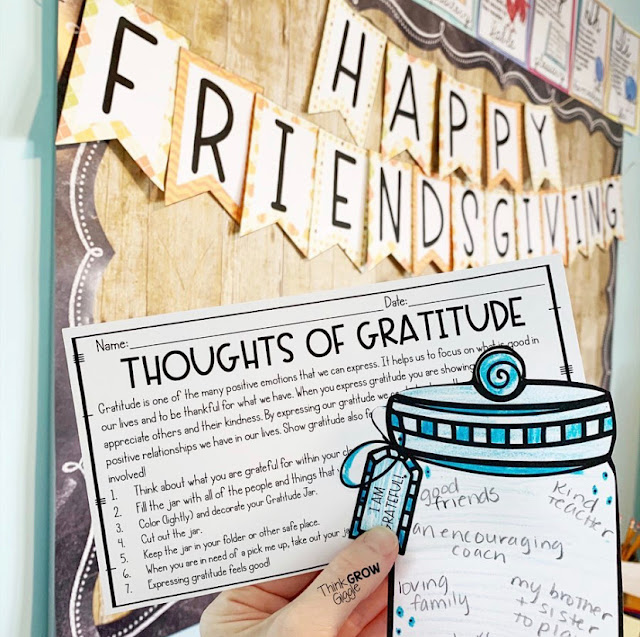


Friendsgiving in the Classroom Display and Activities and Bulletin Board


Letters of Gratitude to Staff

Have students recognize and celebrate the staff at the school who helps them grow. Have students write letters to custodians, the nurse, former teacher, special area teachers, and anyone else that they like. 


In my classroom, we kick this activity off by brainstorming a list of staff members that they can write to at the board. One at a time the students select who they would like to write to and place a tally mark next to their name. This helps us spread the love and allow many different people in our building to get a letter of gratitude.


I love this project because kids can use any paper and get super creative with the cards they make. You can also have students write a poem, write a friendly letter, or fill out thank you note cards. 


Grab some quick tips on how to teach the art of writing thank-you notes and download these FREE thank you templates for your students to use right HERE.


Gratitude Activities in the elementary classroom


I Wish Poetry

Most Thanksgiving activities have students write about what they are thankful for. Those are great for students to reflect on the thanks part of Thanksgiving.


But I love to go a step further and have students write I Wish Poems. This gives them the opportunity to make a wish for the world and encourages thoughts of giving during the Thanksgiving season.


An I Wish poem is a free verse poem that allows the poet to write what they wish for others. In my classroom, we discuss the popular tradition of breaking a wishbone and how the world would be better if we all give our wishes to others.


My students blow me away with the wishes for the world that they write about and they truly make the most meaningful bulletin board display.


Thanksgiving Bulletin Board and Writing Activity


Celebrate Native American Month

November is Native American Month. Celebrate and honor our country's Native Americans by teaching students about their heritage. 


  • Read picture books to celebrate Native American culture. Try these!
  • Research Native Americans native to where you live with this link.
  • Watch videos on Brain Pop Jr about different Native American cultures.


Tie together close reading strategies with rich, American History with passages that celebrate Native American heroes.


Make November a time of gratitude and classroom community building this year! Teach students about kindness, gratitude, and the power of friendships. These lesson ideas will leave a lasting impression on students and encourage students to not only be thankful but to make a change in the world around them.


Love these ideas? Pin and Save for Later!


4 Thanksgiving Activities You Never Thought To Do


Subscribe Today!

Subscribe to get the latest information on educational trends and ideas by email and download a reading graphic organizer set for FREE.

    We respect your privacy. Unsubscribe at any time.


    *affiliate links: “Think Grow Giggle is a participant in the Amazon Services LLC Associates Program, an affiliate advertising program designed to provide a means for sites to earn advertising fees by advertising and linking to Amazon.” (source: Section 5)


    signature

    4 Quick Tips for Using Exit Slips in the Classroom

    exit slips in upper elementary and middle school classrooms

    There sure was a learning curve the year I was moved from teaching third graders in a self-contained setting, to teaching math and science to different groups of fifth-graders. I had to learn how to manage older students, who switched classes and were only with me for a set amount of minutes each day. Gone were the days where I had one group of students all day long, allowing me to catch up with each child at different points throughout the day. I knew that since my time was limited with each class, I had to make the most of every moment. 

    I began to implement exit slips to help me get a pulse of student understanding after the day's lessons. Not only did the use of exit slips help me to grasp student understanding, but it also provided students with the opportunity to reflect on their own understanding of the objectives taught, holding them accountable for their own learning.

    Here are some helpful tips to use when implementing the exit slips in your classroom.

    Teach Your Expectations

    holding students accountable for learning
    Teach your students how to fill out an exit slip when you teach all of your classroom expectations at the beginning of the year. Like any other strategy, you implement in your classroom, completing an exit slip must be explicitly taught. I use four levels of understanding for my exit slips. At the start of the year, we go over each level, what it means, and how students can tell what level of understanding they are at after each lesson. I have the four levels hanging up in my classroom, as well as a small sign next to the exit slip basket. On each exit slip, I expect students to write the topic or objective of the lesson, what level of understanding they are at, and to give a reason or example that proves they are at that level. Sometimes I will write a problem or pose a question and have them complete it on their exit slips. Other times they just express their understanding using their own words. Grab this "levels of understanding" printable for free at the bottom of this post.


    Keep It Simple and Use Consistently

    The exit slips that I use are open-ended. This is helpful for both the students and myself for many reasons:

    • Students always know how to complete the exit slips.
    • They can be used for any subject and any topic.
    • I only make copies of one type of exit slip and always have them on hand.
    • Exit slips can still be used when a substitute is in the classroom.
    By using the same exit slips consistently, students understand how to complete them, improve on their reflections skills, and become accountable for their own learning.

    Ditch the Names

    My classroom runs on student numbers! My homework bins, cubbies, notebooks, everything is labeled with classroom numbers, so our exit slips are no different. I have students use their classroom numbers instead of names so that they feel more comfortable sharing their true understanding of the lesson on the exit slips. At the beginning of the year, we talk all about growth mindset and not comparing your own learning to others' learning. As time goes on and students feel comfortable in our classroom community, they are able to complete the exit slips with honest reflections.

    Use Colored Slips

    One teacher hack that I have found to be helpful for using exit slips with multiple groups of students is to color code the exit slips. With two sections of fifth-grade math and science, I use white exit slips for one group of students and use Astrobrights colored copy paper for the second group of students. This helps me quickly sort the exit slips once they are collected, review them, and adjust my lessons for the next day. Grab the exit slips that I use for free at the bottom of this post.

    There are so many benefits to using exit slips in the classroom. Exit slips are not just for classrooms that switch classes, but for any classroom. They are a simple way to connect with students, have evidence of student growth, address student's individual needs, and reflect on your own teaching.  

    Looking for more ideas for holding students accountable for their learning? Check these out and grab the freebies along the way!


    exit slips in upper elementary classroom


    *affiliate links: “Think Grow Giggle is a participant in the Amazon Services LLC Associates Program, an affiliate advertising program designed to provide a means for sites to earn advertising fees by advertising and linking to Amazon.” (source: Section 5)


    27


    signature

    Small Group Classroom Management Idea

    Small Group Classroom Management Idea

    As teachers, we know that nothing motivates students more than working with a partner or within a small group. This is true for all subject areas. When a partnership or small group works well together there are so many benefits. That is why it is so important to have classroom management in place for small group work, plus it helps build classroom community, too!


    Some include students engaging in meaningful discourse, taking ownership of their own learning, taking risks and sharing ideas, learning from others, and of course strengthening their collaboration and teamwork skills. And these are just a few! We also know that when a partnership or small group does not work well together, no learning takes place, arguments develop, and student relationships become strained.


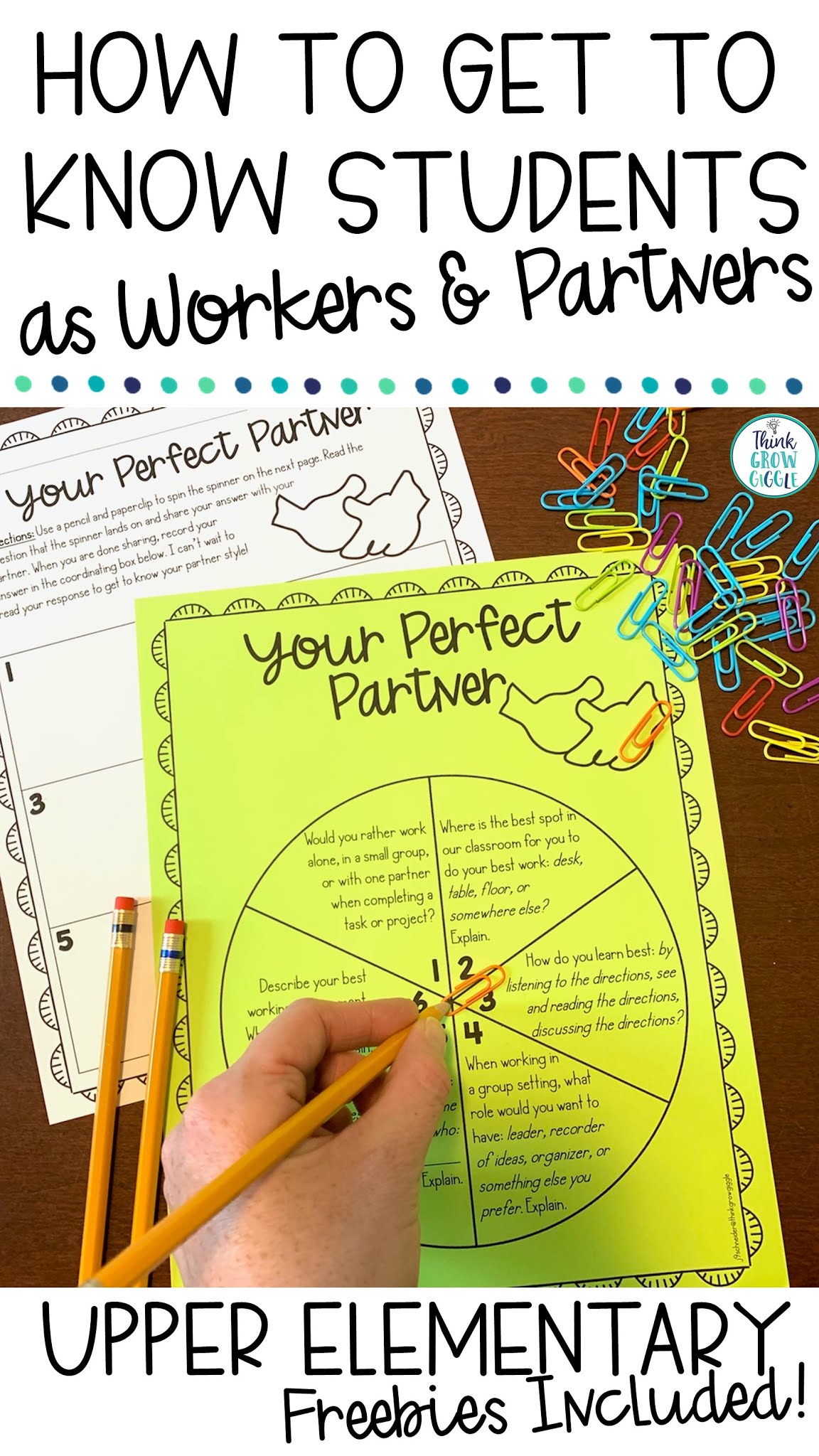
    That is why I love to spend some time at the beginning of the year getting to know how each of my students likes to work, their learning style, and what type of partner they want to work with during project time and cooperative group learning. By discussing this with students and getting them to discuss it with each other, students quickly learn these important lessons:

    • Friends do not always make the best working partner
    • Everyone has their own learning and working style
    • The stronger a group is, the better they can work and learn


    The classroom discussions that take place during the first week of school about individual learning and working styles are my favorite. They not only help me get to know students and better plan partnerships and groups, but it also helps the students to better know each other and their learning styles', and build classroom community too!


    Grab this easy to use and engaging partner activity that I use during the first week of school to help you get to know your students AND to help your students get to know each other at the bottom of this post. 


    👉See more back to school getting to know you activities HERE.


    signature

    All of Your Smart Goals in the Classroom Questions Answered

    setting goals in the classroom


    Setting goals, as an adult or child, is a great way to grow!


    It tells the world that you know what you want to accomplish, and you are ready to overcome any obstacles that may come in your way. That feeling of determination is something that I want my students to experience. 


    Right at the start of the school year, my students set attainable SMART goals, create a plan of action, and then self-progress monitor themselves as they work towards meeting their goals. 


    The entire experience of goal setting is empowering for students as they take ownership on growing academically, socially, and emotionally on different areas throughout the year. What I love about working with students to create their own SMART goals is that it helps to build positive relationships with students right from the start of the year. 


    If you are wondering how to effectively have students create goals and meet them this school year, here are some answers to questions you may have. Grab a pen, take notes, or pin for later, so that you are prepared to kick off the school year setting student SMART goals.


    What is a SMART goal?

    A smart goal is a self-selected goal that is specific, measurable, attainable, realistic, and trackable. Setting SMART goals are individualized and specific to the needs and wants of each student. By setting SMART goals, students have a focus to help them grow in an area that they feel they want or need to improve.


    goal setting upper elementary


    How do you introduce SMART goals with students?

    Students need to understand the concept of setting goals that are specific to their needs, design action plans to meet the goal that they set, and how to check in on their progress. Here is a quick outline to help introduce the concept of goal setting with your upper elementary students.

    • To introduce students to goal setting concepts, I read the book*, Salt in His Shoes,written by Deloris Jordan. This picture book tells the story of Michael Jordan setting goals, creating an action plan, and working to meet the goals he set. This read aloud is a great way to get the students discussing goals that they want to meet this school year and also pairs nicely with growth mindset discussions and lessons.  Or you can read one of these goal-setting books that I love HERE.
    • There is nothing more valuable than getting your students' parents and guardians involved in setting the first goal of the school year. Send home a simple questionnaire for students to complete with their parents to brainstorm and select different areas that students can focus on when setting goals. This gives you the opportunity to see what hopes and wishes the parents have for their children for the school year. (See the form that I send home HERE.)
    • Go over the acronym of SMART so students can digest each element of setting SMART goals. Students should know what each letter of SMART stands for to help them plan out their own goals. Since setting goals is an ongoing process for the school year, create a bulletin board of SMART goal resources that will help students as they create different goals throughout the year.


    How do students select a SMART goal?

    By the time that students will be formally setting their own goals, they will have had a chance to think about different areas of focus. For the first SMART goal of the year you might choose to have everyone work on a goal in the same area, for example math. This would mean that every student is working on a math goal, but their individualized math goals are all different. Some students might be focused on problem solving, others on fact work. Or, you might have students select any goal that they want to kick the school year off with. There is no right or wrong way to have kids select goals.  


    Whichever you choose, follow these two quick steps:

    • Interview each student individually to get to know their strengths and weaknesses. This is a quick process with many benefits. Not only will it help you to get to know students on a personal level, but it will help you to guide students on creating the best SMART goal for them. (Grab the interview form that I use for FREE at the bottom of this post.)
    • Brainstorm. Have students use pencil and paper to record all of the different ideas that they have. They can use SMART goal sentence starters to help. I always use an inverted triangle brainstorming sheet to help kids get very specific. When students have specific goals, it is easier to set an action plan and monitor their progress. Be sure to model the process of brainstorming so that the students truly understand what is expected.

    setting goals back to school

    How can students self-progress monitor their goal work?

    Have students create an action plan to help meet their goals. Their action plans will be specific to the topic that they have for their goal, but can include simple steps such as:

    • spending more time checking my work
    • reading more challenging books
    • asking for help when needed
    • creating my own practice fact cards

    Be sure to help students know where they can go in the classroom for extra support materials and tasks on the topic of their goal. One way you can do this is by having different buckets of support materials in math and language arts. When they know there are support materials in place, they can add that to their action plan. 


    Another way to add support for students is by providing them with appropriate websites to support their goals. Students will instantly become invested in meeting their goals and will look forward to doing any additional activities that they have listed on their action plan, especially during small pockets of downtime in the classroom.


    Once students have their action plan in place, set a schedule for students to self-monitor how they are progressing towards meeting their goals. Starting with a weekly check-in is a great way to send the message to the students that setting and monitoring goals is something that you value. Be sure to hold students accountable by having them complete check-in forms. It can be a quick response to one or two questions that you pose, or something more detailed. As long as students are being held accountable it will help you track how students are doing. 


    back to school goal setting


    The goal has been met, now what?

    Celebrate! This is the best time to teach students that goal setting is ongoing. Once students have reached a goal, celebrate it, and have them set another goal. Students will be reaching goals at different times throughout the year and that is ok. Once students understand how to set goals, they will easily be able to set a new goal. I encourage students to focus on a different area for each new goal. Remember goals that students set can be academic, social, or behavioral. Encourage students to mix up which types of goals that they are setting.


    Setting SMART goals is a great way to kick off the school year and set the tone for students that they will be working hard this year as individuals meeting their own goals. It also helps you to build strong relationships with students on an individual level, showing each and every student that you are invested in their success. By doing this, you are setting up a positive climate in your classroom where students feel valued. 


    Check out my favorite goal-setting activities HERE. 


    LOVE these ideas? Pin to save!

    back to school goal setting


    *affiliate links: “Think Grow Giggle is a participant in the Amazon Services LLC Associates Program, an affiliate advertising program designed to provide a means for sites to earn advertising fees by advertising and linking to Amazon.” (source: Section 5)


    34


    signature
    Back to Top