Showing posts with label reading conferences. Show all posts

Making Inferences Teaching Idea for Upper Elementary Students

inference activity for upper elementary

When it comes to reading strategies, making inferences is one that students must master in order to dive deep into other reading units such as understanding characters, questioning, and themesInferring is the groundwork for developing readers. It propels them forward as readers, giving them the skills that they need to dive deeper into texts and understand more challenging concepts such as symbolism and foreshadowing.

So what is an inference? An inference is a conclusion made by the reader using text evidence and background knowledge to understand the author’s intended meaning. 

Making inferences is no easy task. It requires careful reading work from the reader including collecting important text support and evidence. So how can we make sure that students are inferring, and inferring successfully, too? By taking a step by step approach, using concrete examples, teaching student monitoring and self-reflection strategies, and providing ample opportunities to practice inferring students will not only understand how to successfully infer, but will become more engaged readers, inferring on each and every page as they read.

When it is time to begin our inference unit, I always begin with this easy to implement lesson that always gets my students hooked on making inferences! All of your students, including struggling readers, will be engaged and understand the concept of inferring immediately! Follow these steps and your students will become experts in making inferences, in no time. (Grab resources for this lesson for FREE at the bottom of this post.)


1. Setting the Stage to Infer

I love to kick off inferring in my classroom with an introduction activity that provides a concrete visual of how to make an inference. This inferring activity is based on the book, The Wretched Stone by Chris Van Allsburg. Before a read aloud of this book, I go over two important concepts I want the students to remember, first is what I call the making an inference secret equation and second is the 3 steps of inferring that I teach my students to use as readers to help them to make an inference.


Grab the free printables that go along with this lesson!

Making an Inference Secret Equation

When it comes to making an inference, I tell my students that they cannot
infer without using the secret equation. This secret equation is a visual reminder of how to infer. Using the yellow + blue = green concept, students are able to remember that in order to infer, they need to use story evidence (yellow) and background knowledge (blue) to make an inference (green).


making inferences activity for upper elementary kids

3 Steps of Inferring  

After we go over this secret formula, we go over the following simple steps that readers do when making inferences:

Ask What You Already Know: Ask yourself what you already know about what you are reading that can help you to make an inference.
     Ask "Thick" Why Questions: Ask thick questions as you read to make inferences about what is happening in the text. Ask “why” questions to help you infer. Avoid asking questions with one-word answers.
Answer The Questions You Asked: Collect story evidence to answer the questions you asked as a reader. Now infer.

A Simple Way to Teach Students to Make Meaningful Inferences

Note: This lesson is taught after I teach questioning so students are fully aware of the differences between thick and thin questioning.

2. Get Students Hooked

Once I have gone over the secret formula and the three steps, I engage the students to infer even more before our read aloud. Here is how:

  • I take out three empty cups, a jar of water, and food coloring. 
  • I enlist the help of students to pour water into two of the cups and add a few drops of yellow dye into one cup of water to represent the story evidence we will be collecting during our read aloud. 
  • Another student will add a few drops of blue dye in the second cup of water to represent the background knowledge that will help make an inference.

One of the three cups is left empty. This cup is empty because we have not yet made our inference. By the close of the read aloud, we will combine all of the story evidence yellow water and what we already know blue water and form an inference we will have a cup of green water, and voila…an inference is made!


A Simple Way to Teach Students to Make Meaningful Inferences

Time to hook the readers with a read-aloud of the Wretched Stone

If you have not 
read the book, The Wretched Stone by Chris Van Allsburg, it is centered around a large rock that is found on a mysterious island and negatively changes the ship’s crew that brought it aboard. Spoiler alert, the stone is a TV. During the read-aloud of The Wretched Stone, we stop periodically to ask thick questions and record story clues and evidence, along with our background knowledge on a T-Chart to help us infer what the wretched stone could be.

making inferences activity for kids

The students are usually stumped about what the wretched stone could be
throughout 
the reading. Following the reading, we review all of our clues and all of our background knowledge from the chart and it becomes clear what the stone really is. I emphasize to the students that the more clues and background knowledge that we have, the easier it will be for us to infer. 

At this point, the student who correctly infers that the stone is a TV, comes up 
and combines the yellow and blue water into the empty cup, and we have a cup of green water representing the inference made by using story clues and background knowledge. 


making inferences graphic organizer

A Simple Way to Teach Students to Make Meaningful Inferences


This lesson is a great concrete visual for the students to remember what an inference is and how to make an inference, too. It also shows how making an inference truly helps you to understand the author’s theme and message. This inferring lesson is one that students never forget, making it perfect to refer back to as students continue to practice inferring throughout the year! (grab resources for this lesson for FREE at the bottom of this post.)


A Simple Way to Teach Students to Make Meaningful Inferences


3. Teach Students to Self-monitor

Making inferences is a tricky concept and requires many lessons and activities. Students must learn how to reflect and self monitor the inferences that they are making. As students read longer and more complex texts, students’ inferences will need to be adjusted as they collect more story clues and evidence. Using a continuum style self-monitoring chart, students can see how they are growing as readers on the path to making powerful inferences to help them understand the stories they read more deeply. I have a chart size poster of this continuum in class and students keep a copy in their reading notebooks so that it can be easily referred to all year long! This is a great tool to refer to during your reading workshop one on one student conference to help guide your discussion. 

4. Practice, Practice, Practice!

making inferences quotes for teachers marzanoWhen it comes to making
inferences, continual practice is a must! In my classroom, we practice making inferences in isolation with short text and inaction while independently reading. Using task cards, short texts, and picture books, students can work together to practice making inferences. Once students are able to successfully make inferences in isolation, we transition to making inferences before, during, and after we read. Graphic organizers, note sheets and sticky organizers are all ways that students can record text evidence that helped them to make inferences.

Making inferences is hard, but rewarding work. It is a skill that must be 
explicitly taught and practiced continuously.  

Being able to successfully make inferences while reading is a foundational skill that students need in order to go beyond the basic comprehension of a book.

It allows them to understand the author’s meaning, compare themes, and fully grasp complex character development. By inferring as they read, students become active readers and begin to fill in the blanks, really searching for the author’s message and information that was not directly given to them in written words.


Looking for more inference book activities? Try these!


LOVE these ideas? Pin to save!


making inferences activities and strategies for kids


*affiliate links: “Think Grow Giggle is a participant in the Amazon Services LLC Associates Program, an affiliate advertising program designed to provide a means for sites to earn advertising fees by advertising and linking to Amazon.” (source: Section 5)

93


signature

How to be Organized for Reading Conferences

organizational tips for reading conferences


I am often asked how I organize my materials, and what materials I bring along, when I hold reading conferences with my students during reading workshop


Having a designated reading conference toolbox or basket is a great way to be prepared, organized, and house all the materials that you need when you confer with students individually. By creating a toolbox or basket of the materials that you need ahead of time, you are able to use the time you have with students effectively, and not scrambling around looking for materials. Some of the materials in my toolbox are specific to a unit, so each time our unit or area of reading focus changes, I swap out those materials.


reading conference conferring guideHere is the low down on what is in my reading conference toolbox that I bring along to every reading conference I hold!

  1. Conferring Guide to stay on track
  2. Data Collection Forms or Notebook 
  3. Reader Take Away Cards
  4. Reading Strategy Teaching Points (Grab the set of teaching points that I use at the bottom of this post.)
  5. Previously Read Picture Book
  6. Previously Read Chapter Book
  7. Basic Supplies: pens, pencils, highlighters, sticky notes, book marks
  8. Reward Stickers for reader shutouts during mid workshop break

Be sure to bring along both a previously read picture book and a chapter book that was just recently read with the whole class during the unit you are currently in. These books are so important to bring with you as you can refer back to them when teaching and modeling with the student during your conference time. Since the book is familiar to them, they will be able to focus on the learning of the reading strategy you are teaching them, and NOT the comprehension of the book.


No matter what is in your reading conference toolbox, make sure it is items that will help you make the most of your one-on-one time with your students to discuss the books that they are reading and to help them grow as readers.

We are so excited to get this school year rolling and helping you focus on easy classroom management! Check out these other classroom management ideas for upper elementary!


Pin for later!


classroom management tips upper elementary


24


signature

Highly Effective Strategies for Launching Reading Workshop


reading workshop kick off upper elementary


There is nothing more exciting than the first few days of school! I love the smell of fresh pencils, the bright colors on the bulletin boards that have yet to be faded, and the eager faces of the students scanning the shelves of their new classroom library looking for their first read of the year. Preparing to launch reading workshop is by far, my favorite part of those first few days and weeks of school. I love reading aloud to my students, teaching reading strategies, talking about books, and of course helping them understand how to grow as readers during our workshop time.

If you are getting ready to launch your first reading workshop, or if you are looking for more ideas to enhance your already crafted workshop launching lessons and reading conferences, these tried and true tips and strategies will make your planning and running your reading workshop time stress free!

readers workshop kick off upper elementaryDon’t let the planning portion of running reading workshop stress you out! Since the workshop model follows a consistent routine, once you get the hang of the system, it is easy to duplicate, day after day. Click HERE to read how I plan for the 3 important parts of each reading workshop lesson and grab FREE workshop planning templates, too!


readers workshop kick off upper elementary
Reading workshop is highly effective for growing readers! The most important part of launching the reading workshop model is the mini-lesson. But sticking to an only ten minute mini lesson can be a challenge!  Click HERE to read my best 6 tips for keeping those all important mini lessons mini and scoop up some FREE reading workshop goodies, too!

reading workshop kick off upper elementary
One important focus of reading workshop is to build student stamina. One way to increase students’ stamina is to use the mid-workshop break. This strategy needs to be taught to your students, but once they understand how to use their break time, it will truly help them grow as readers! Click HERE to read my 3 favorite ways to effectively use the mid workshop break to engage readers of all levels and grab a FREE partnership discussion guide to keep students engaged in meaningful discourse!


reading workshop model in upper elementary classroomReading conferences are the highlight of my reading workshop block! I love to get right next to students in their working area, discuss the book that they are reading, and offer them their own personalized mini-lesson to help them grow as readers! Click HERE to find out my 3 best and easy to implement tips for reading conference success. You won’t want to miss these ideas to keep your conferences on track to help your students succeed as readers! Scoop up some reading workshop freebies, too! 

When it comes to holding effective reading conferences with your students during
reading conference toolbox
reading workshop time, organization is key! During reading conferences, I love to carry around my reading conference toolkit filled with everything that I need to confer with my readers. Using a conference toolkit allows me to maximize the little time that I have with each student since everything is right at my fingertips! Click HERE to find out what is in my reading conference toolbox, grab ideas, and a FREE printable to help you make your own toolbox, too!


Kick off the year celebrating reading with these ideas and free activities that will have you and your new bunch of students building a community of readers one day at a time! 


I truly believe in the workshop model to help students not only grow as readers but to love reading, too. By using this model, you not only grow students as individual readers, but you create a classroom culture and climate that truly loves reading and all things books! 


Pin now to save these ideas for your reference later!


41


signature

3 Tips For Successful Reading Conferences


reading workshop conferences


Conducting reading conferences with your students is an important part of reading workshop. 

A teacher-student reading conference takes place during independent reading time within your reading workshop block.  During this quick one-on-one meeting time, the teacher listens to the student read, they discuss the book that they are reading through discourse about the reading strategies that the student is using, and the teacher compliments the reader and gives them a suggestion or tip to use as they continue to read. 

By conferring with your students you are giving them one-on-one time devoted solely to improving their individual reading skills. It is reading differentiation at its best! Reading conferences allow students to get tailor-made individualized mini-lessons suited just for them!


It is important to make the most of the time that you have for your reading conferences. This will ensure that the student you are conferring with gets reading strategy work that will help them get stronger as a reader. Grab a reading workshop kit for FREE below.


Here are some ways that I have found that work for me to make the most of your individual reading conference time.


Be Organized


reading workshop conferencesPlanning for reading conferences can be challenging. Students that you planned on meeting with might be absent during your reading time, your mini-lesson may run over time, and students you thought were ready to work alone, may need a little extra support to help get started independently. All of these interferences cut into your reading conference time, meaning you will not meet with as many students as you had planned. My goal is to always meet with about five students each day. This ensures that by the end of the week I would have met with all of my students at least one time. 

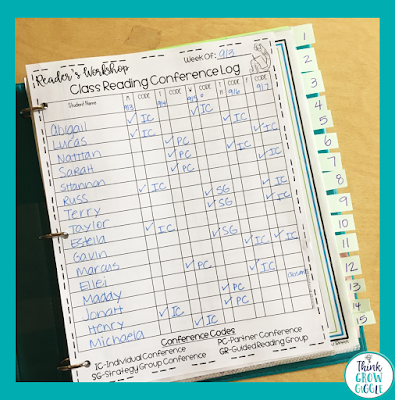
To help me stay organized, I keep a reading conference log right at the front of my binder. It is completely organized to keep track of the conferences that I have had and which type of conference it was. Although traditional reading conferences are between the teacher and one student, I also utilize partner conferences and strategy group conferences as teacher conferring opportunities. These type of conferences do not occur as often, but there are days that students work together on reading tasks, so when I meet with them as a pair, we all confer together! I also mark this sheet with information that will help me keep track of student growth such as absences or when a student is pulled out of my classroom for additional services. This page serves as a great tracking system! This sheet is also helpful for planning. Before reading workshop begins, I can quickly look at this page and know which students I will need to confer with that day.


Be Prepared


reading workshop conferencesHaving a reading conference toolbox is a great way to be prepared for all of your reading conferences. 

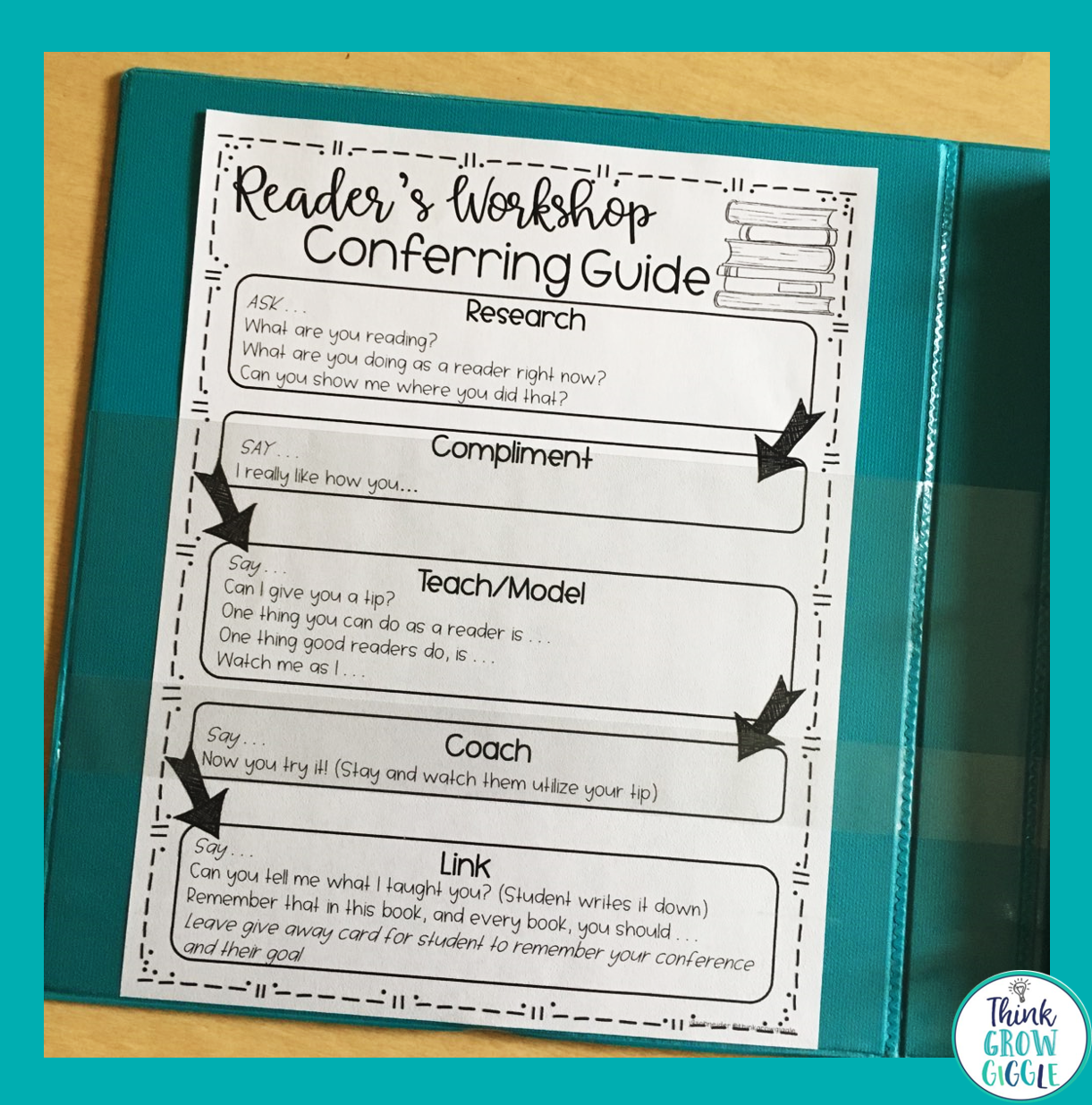
Inside my reading toolbox are the essentials that I need to meet with each student for their reading conference. It contains a reading workshop conferring guide to keep me on track, a previously read picture book from the current unit of study, so that we can refer back to it together to review strategy work, conference datasheets for me to take notes on, reader take away cards so that I can leave the students with a handwritten compliment and suggestion,  and of course pencils, highlighters, pens, and sticky notes!

Having student data sheets are a must! The more detailed notes you take during the conferences, the better you are able to help each student as an individual. You can use a plain notebook and take detailed notes, making sure to note the student's name, date, and book that they are reading, or you can use very detailed note sheets to track reading fluency, include strategies, and your entire discussion. Both work well, so pick the style that works for your! Just be sure to keep track of each and every conference that you hold with each student. 


Be Positive


reading workshop conferencesAlways, always, start your reading conferences off with a positive vibe, to ensure that the students are excited to see you approach them for a reading conference. When you first get next to your student for a conference be sure to give them a compliment about what they are doing. Some suggestions for compliments could include student organization, the student getting lost in the book, student taking notes, student use of reading strategies, or student fluency after you listen to them read. The more positive and celebratory that you are, the more the student will continue to do what you celebrated as they read independently. Be sure to always mix up your compliments each time you meet with a student.


Be Present: Leave Your Voice Behind


reading workshop conferences

reading workshop conferences


I love using these reader take away cards to help students stay on track while they independently read. I use them in two different ways. 

The first way I use them is during our reading conference. I will take quick notes on each card as we speak, including a compliment and a suggestion. When I leave, the reader gets to keep this card. They can use it as a bookmark, keep it in their reading folder, or staple it to their reading notebook page. When students forget their focus or goal, they can take out the card and remember our conversation during our conference and “hear” my voice once again coaching them along. 

I also use these reader cards on days that I did not meet with a student to confer, especially if a few days have passed. I will collect student notebooks or activity pages and correct it, and fill out a reader card with a compliment and suggestion just as if we were having a conference. When the student’s work is returned, they will see the reading card and know exactly what they are doing well and what they need to focus on as they continue to read. These cards are a great way to keep track of your conferences, too! 


Reading conferences are a powerful tool to help your students grow as readers, but they must be planned and purposeful, just like all of the other elements of reading workshopThese tips and strategies will help you to make the most of the time you have to confer with your students. 

If you are looking for more tips, check out the professional reading book: Conferring with Readers. I love this book and refer to it often! It is a great professional read to help you understand the ins and outs of reading conferences.


*affiliate links: “Think Grow Giggle is a participant in the Amazon Services LLC Associates Program, an affiliate advertising program designed to provide a means for sites to earn advertising fees by advertising and linking to Amazon.” (source: Section 5)


273


signature
Back to Top