Showing posts with label Writing Prompts. Show all posts

3 Ideas for Student Biography Research Projects Upper Elementary

3 Ideas for Student Biography Research Projects


When the second half of the school year comes around, it is officially biography season in my classroom!


That is because when the second half of the year comes we shift our focus during reading and writing to nonfiction and informative text. The engagement is instant as kids just love to read nonfiction. After we get our feet with reading a wide range of informative texts, we begin to closely study biographies.


Students LOVE to read about real people and the impact that they have had on the world. Every year students are always so motivated during our biography research project time. Our biography project is the first research project of the year, so it is important to me that I support them every step of the way.


Over the years I have found that by breaking down the process step by step for our biography reports students are not only successful when writing their first research essay of the year, but they are able to take the skills that they learned throughout the unit and apply it to future research projects that we do, like studying endangered animals and National Parks


Continue to read to find out how I approach teaching BEFORE I expect students to research and write an expository research essay.


1. Break Down Biographies
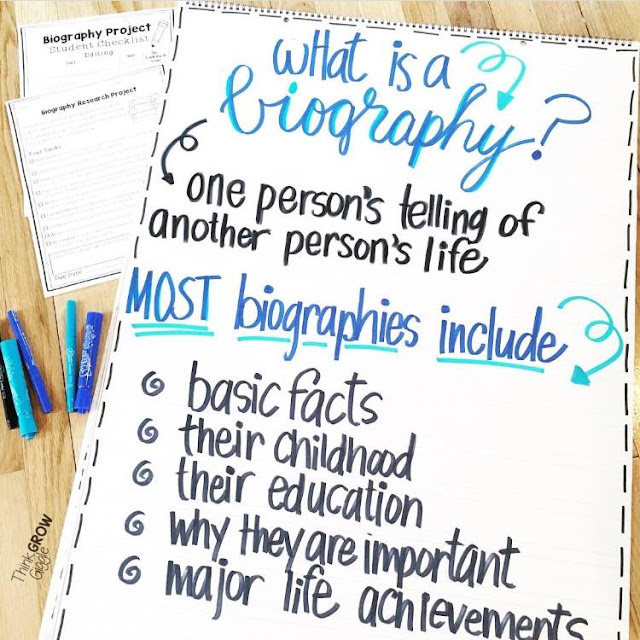
Biography Anchor Chart for Upper Elementary


Breaking down the genre of biographies is a great way to kick off a unit on biographies. Since we study biographies during our nonfiction reading unit, I start by connecting biographies to other nonfiction books that we have read. 

Creating an anchor chart together, I am sure to include that biographies:

  • are one person's telling about another person's life
  • can be about people who have died or are still living
  • include basic facts about the person of focus
  • include information about the person's education and childhood
  • usually tell about problems or struggles that they faced
  • describe their major life achievements

Once we have gone over the characteristics found in biographies we get reading so that students can find these characteristics in action.


I start by reading a few short biographies like the ones found in anthologies like this one, Herstory written by Katherine Halligan:
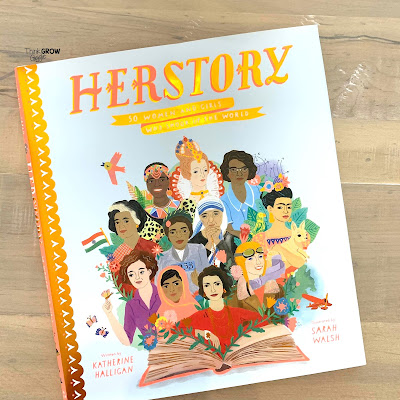


Biography Reading Mentor Text Upper Elementary


We stop and discuss the elements that we listed on our anchor chart. I have students find examples of struggles, accomplishments, and facts.


Once students have listened to a few biographies, I send them off to annotate a biography article


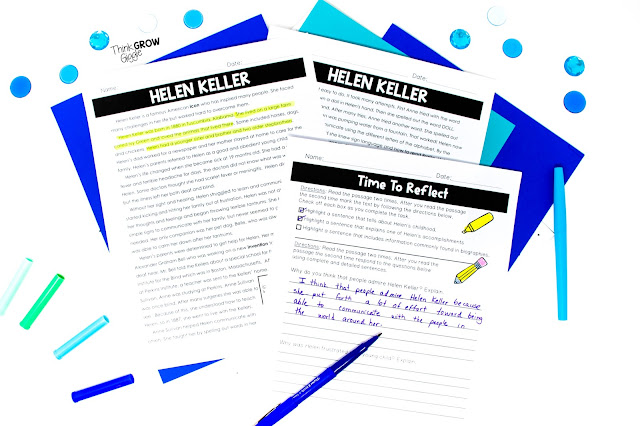
Annotating a Biography for Upper Elementary Students


Students take highlighters and sticky notes and mark up the text, citing where they found elements of biographies. This activity works well in partnerships so that the students can discuss each element with a peer.


At the close of this first lesson on biographies, I send students off with the task to think about a person that they would like to research. While I do like to encourage students to pick someone they are interested in, I do also guide them on who they select.


I tell my students to pick someone who has had an impact on the world and someone who is not a movie/TV/YouTube star. You can make any rules you want to help guide students or set no rules. I have found that spending a few minutes brainstorming appropriate people to research sets the tone for the whole project. That is why before we wrap up the lesson we brainstorm ten people who would be great to research. This brainstorming is just to get students excited and thinking. They do not have to pick from the brainstormed list.


The next day, after students have had time to think, and discuss it with their families, which I like to have them do, they submit their research request. They simply write their name on a piece of paper and the name of who they want to research and why. This is a great way to get students to pick someone intentionally and reduces repeat research projects. I never allow more than two people to pick the same person.


Grab the FREE form I have students use to request a focus person and guide right here.


2. Bring it Through the Writing Process
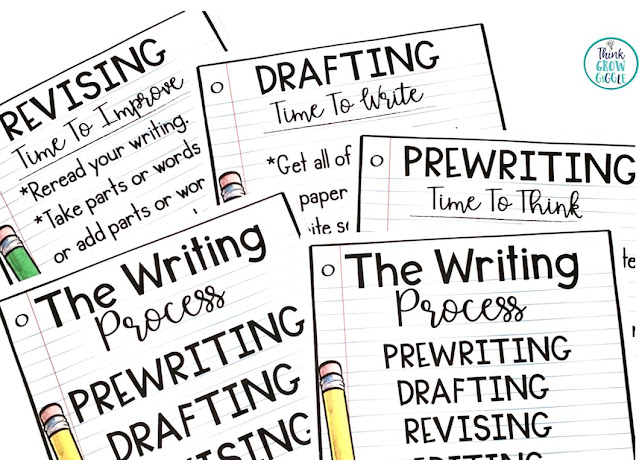
Writing Process Activities for Biography Research Elementary Kids


It is important to remember to directly teach students how to take notes during their first research project. Before students go off on their own to read and collect information for their reports, I teach students how to take notes. We use T-charts and Boxes and Bullets to help us keep our information organized.


A T-chart is easy to make and easy to use. On one piece of paper, students make a large T. One side keeps track of students' questions and on the other side, the students record the information that they found that answers that question.  Boxes and bullets are easy to use too. Students write the topic or main idea in a box, and below the box, they bullet information that supports that topic or main idea. Whatever note-taking strategy you use in your classroom be sure to explicitly teach students how to use it using any biography mentor text.


Once students have a good grasp on how to collect information, they are ready to work independently. I assign one topic for research each day. This helps the students stay focused on the daily task and make a research project manageable for upper elementary students. The breakdown I use for each day's research looks like this:


  • Day 1: Family Life and Early Childhood
  • Day 2: Young Adult Life
  • Day 3: Adult Life
  • Day 4: Accomplishments
  • Day 5: Other Important and Interesting Information


Sometimes days are combined based on what resources students are using to collect information. Once students have collected information for their report, we pause our research and return to the writing process.


Students know that we use the writing process for all of our writing. However, mini-lessons in certain areas specific to informative writing are necessary to help students write their first research project. Mini-lessons I teach before students write that are specific to informative writing include:


  • hooking your reader
  • paragraph organization
  • citing sources
  • strong closure to wrap up your writing


Teaching students how to take notes and what to do with their notes helps them successfully write their first research project.


3. Get Student Creative Juices Flowing

Creative Biography Project Ideas for Kids


Once students have researched, collected information, written their project that has been taken through the writing process they are now ready to get creative and share what they learned.

Over the years I have done a wide range of presentations from oral reports, to PPT, dressing up as the person they researched, and everything in between.

I have found the best projects and presentations come when students are given choices. I do require students to create a scrapbook as if they were the person of focus which gives them a deeper understanding of who they studied.  By creating a scrapbook filled with illustrations, tokens, and writing students truly get to know their focus person.

In addition to the scrapbook activity, students can select one of the following to share what they learned:

  • design a PPT presentation
  • create a tri-fold handout to teach others
  • create a puppet of the person
  • design a poster
  • prepare a speech as if they were the focus person
  • allow students to come up with an idea for their presentation. I have to approve their idea based on the resources and materials we have available in the classroom.

When students present their projects in my classroom, dressing up as the person they researched is completely optional. Since the entire project from start to finish is completed in the classroom, students' projects are truly their own. They have worked on the entire thing and have a huge sense of accomplishment. These are for sure the best projects of the year! 


When biography season comes around in your classroom, be sure to follow these tips for success! By breaking down biographies, using what students already know about the writing process, and allowing creative choice when it comes to project displays your students will be engaged, motivated, and write the best biography research projects you have ever seen.


You might be interested in reading:


Looking for more high impact writing resources? Click the HERE.
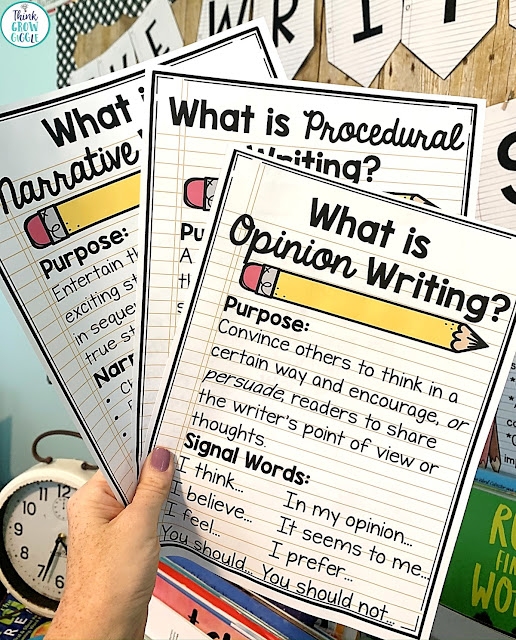


Writing Posters and Anchor Chart Bulletin Board Display Elementary


                    LOVE these tips? Pin to save!


Biography Project Ideas, Tips, Templates, Lessons Upper Elementary


*affiliate links: “Think Grow Giggle is a participant in the Amazon Services LLC Associates Program, an affiliate advertising program designed to provide a means for sites to earn advertising fees by advertising and linking to Amazon.” (source: Section 5)



signature

Holding Debates in the Classroom ideas Upper Elementary

Holding Debates in the Classroom ideas Upper Elementary Middle School


Whether you are getting ready to learn about Groundhog Day or learning about persuasive writing, holding a classroom debate is the perfect activity!

Turn your classroom into a courtroom and hold your own high-interest debates in your classroom to engage students and practice persuasive writing, argumentative discussions, and speaking and listening skills in a safe and structured environment. 

Debates provide students with the opportunity to see that it is OK to disagree with their peers. It also helps them to understand different perspectives and points of view on a variety of topics. 

This can include different holiday and seasonal topics like to have more winter or early spring (think Groundhog Day), should pranks be allowed at school (think April Fools Day), or a generic high-interest topic like, should homework be assigned? which is perfect to tie into Election Day activities!

I love using debates in the classroom. 

Not only does it address multiple skills and objectives, it allows students to put all of their persuasive writing strategies and knowledge into action within a real world activity.

While working on debate projects, students will sharpen ALL of these skills:
  • persuasive writing
  • reading
  • research and note-taking
  • point of view
  • listening and speaking
  • collaboration and teamwork
  • public speaking and eye contact
  • conversation etiquette

The best part about holding debates is that it is naturally engaging for students. By directly teaching students how to participate in a debate even your most timid students and reluctant writers will be ready to participate.

Here is how I break down and explain this genre of writing for my upper elementary students to help them understand the nuances specific to debates, as well as make connections to persuasive writing.

What is a Debate? What is Persuasive Writing?

Writing debates is always part of our persuasive writing unit. I love that debates give students the opportunity to use their persuasive writing skills in real-world situations. Here is how I define both persuasive writing and debates for my students:
  • Persuasive writing is a form of opinion writing used to convince others to think in a certain way and persuade the readers to share the writer's point of view.
  • A debate is a formal argument in which there are two sides that take opposing viewpoints and discuss them in an organized and structured way while trying to persuade listeners to share the speaker's point of view. 
By using these definitions, students can easily see the connection between persuasive writing and debate work. We also discuss that a judge will listen to both sides of the debate and decide which side made a better "case" and supported the argument.


Why Participate in a Debate?

How to Hold Debates in Your ClassroomIt is important to me to let students in on the "why" behind the lessons that I teach. When students participate in debates they develop listening and speaking skills. They begin to understand both sides of an argument and gain perspective from their peer's point of view. Additionally, by practicing public speaking in the form of a speech, students' fear of speaking in front of peer groups will decrease. Students need a lot of time to practice speaking in public. Help students get over any insecurities and fear by having them work in groups to debate different topics throughout the year. The more practice they have, the better!


What are Genre Specific Key Words?

Just like other writing genres have key words to signal key points, so do debates. Together as a class we brainstorm persuasive writing words that would help them successfully write an organized debate speech. For example, In my opinion, Consequently, Therefore, Specifically, That is why, are some key words to help you get started brainstorming with your own students.


How are Debates Organized and Written?


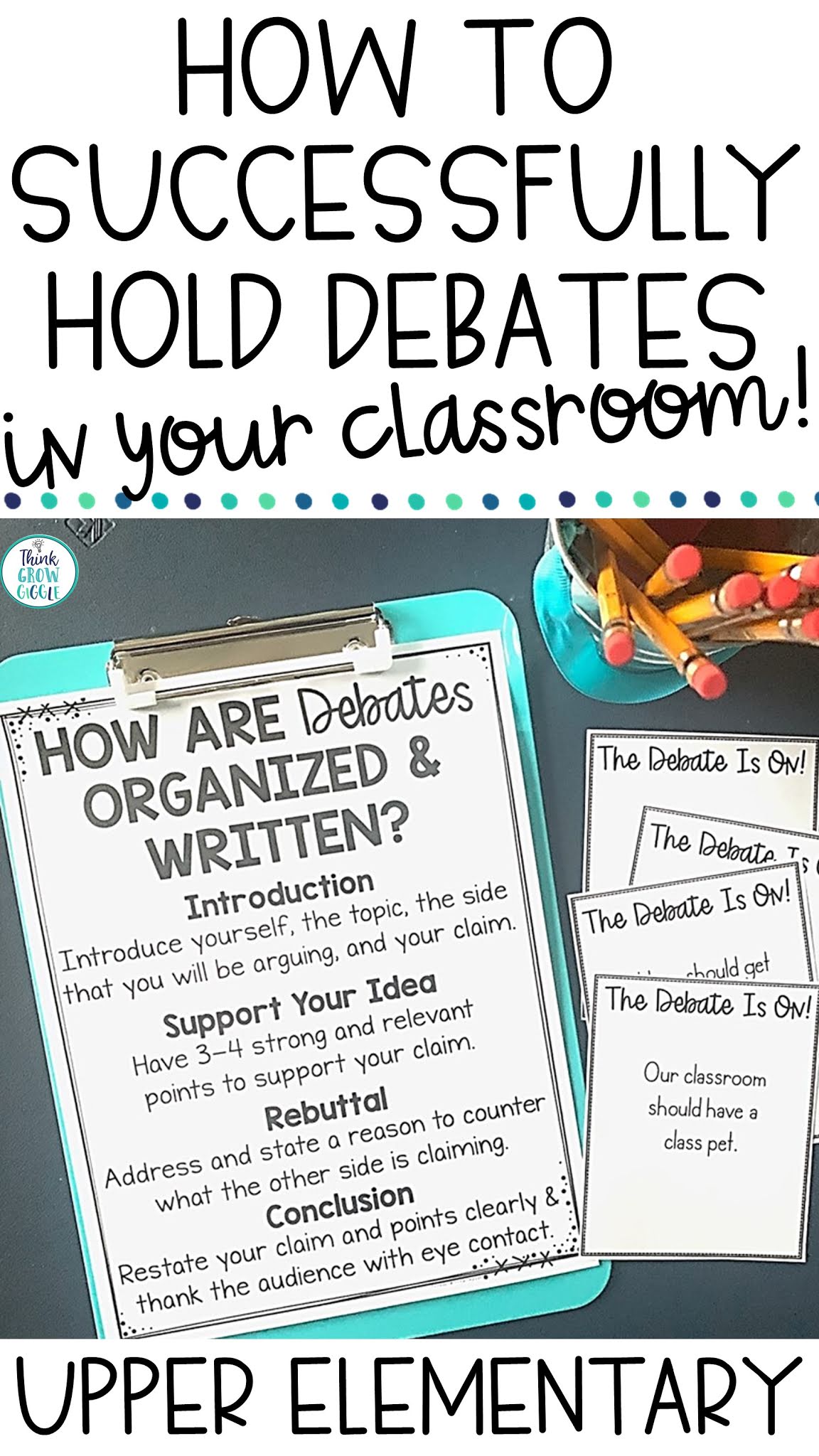
debate templates prompts and free lessons for kidsDebate speeches are organized in a familiar format for students. It begins with an introduction, requires supporting details, and ends with a conclusion. This is the same structure that students use when writing about reading. The major difference is the rebuttal component. The idea of a rebuttal is new for upper elementary students so it takes center stage of my lessons. Here is the debate structure I use with my students:
  • Introduction: Introduce yourself, the topic and the side you will be arguing for, and your claim
  • Support Your Idea: Have 3-4 strong and relevant points to support your claim
  • Rebuttal: Address and state a reason that will counter what the opposing side is claiming
  • Conclusion: Restate your claim and points and then thank the audience with eye contact.

What Makes a Debate Different than Persuasive Writing?

How to Hold Debates in Your Classroom
The key elements that students need to understand when it comes to debates are pros, cons, and rebuttals. To fully understand these concepts students need direct instruction and practice. I love to use modeled writing to help students identify the different elements of debates, especially these three areas:
  • Pro: The pros or proposition side of a debate is the affirmative side. It is the why you believe in the side of the topic you are debating. The pros are for the topic at hand.
  • Con: The con side of a debate is the negative side. It is the why you do not believe in the topic. A con is against the topic at hand.
  • Rebuttal: A rebuttal is a statement made about the opposing side's claim to explain why their claim is wrong.


What are the Steps of a Debate?

Once students write their debate speeches it is time to actually debate. Since debates are structured and organized in such a way that allows both sides to have equal time to speak, students must be aware of the format. Here is a shortened version of the debating speaking order that I use with upper elementary students.
  • Affirmative side speaks to state their claim and supporting details.
  • Negative side speaks to state their claim and supporting details.
  • Negative side states their rebuttal and closing.
  • Affirmative side states their rebuttal and closing.


A Few Tips and Tricks...


    How to Hold Debates in Your Classroom
  • Help students prepare for the debate by creating a checklist to keep them organized.
  • Allow students to pick their own side or mix it up by randomly assigning which side they will be "for". This is a great way to differentiate for your top writers, too. 
  • Assign cooperative group roles to help students stay on track! I have found the best roles to use for debating units are recorders, time keeper, and speakers.
  • Do not try to have students memorize their speeches. Instead, have students write their speeches in bullet form to help them read it fluently while they are presenting.
  • Encourage students to practice their debate speeches within their small groups several times before presenting to help build their confidence.
  • Since speaking in front of their peers can be intimidating, help them feel positive by giving a lot of encouragement and positive praise.
  • Make it fun! Make the kids laugh and giggle at YOU by dressing up as a judge complete with a gavel to take the pressure off the kids!
  • Use the holidays and seasons to engage students in meaningful topics to debate:
  • Use current events and topics of interest for debates, such as:


Holding debates in the classroom is a fun and engaging way to keep students working hard and practicing so many different skills at once. Provide students with many opportunities to debate over topics in the classroom. Not sure of an idea to have students debate about? Ask them! They always come up with the best topics to debate. 


You might be interested in this printable AND digital debate resource.


Love these ideas? Pin for later!

debate activities and lessons for elementary


*affiliate links: “Think Grow Giggle is a participant in the Amazon Services LLC Associates Program, an affiliate advertising program designed to provide a means for sites to earn advertising fees by advertising and linking to Amazon.” (source: Section 5)


signature

3 Halloween Writing Activities for Upper Elementary

halloween writing prompts

There is nothing more motivating to upper elementary students than the holidays!


I love to use special days throughout the year to engage students across content areas. We read holiday and seasonal picture books, practice close reading strategies with nonfiction holiday passages, play holiday games during math, and of course, you can find holiday writing activities adorning the walls.


There is no holiday or season more exciting to students than Halloween! Here are my favorite writing activities to do with students to harness all of their Halloween excitement into focused learning opportunities.


Haunted Haiku Writing
Fall themed alternative: Harvest Haiku 


Haiku poems are focused on one narrow topic and written with exactly 17 syllables. 

Since haiku poetry follows a strict pattern, all students, including struggling writers, see this form of poetry as an attainable task that they will finish successfully. 

Have students write a Halloween haiku about any Halloween topic they like, or create a brainstormed list of topics together as a class such as: candy corn, bats, spiders, costumes, and ghosts. Teacher tip: Write each topic from your brainstormed list on small pieces of paper and place them into a basket. Next,  have students select a topic from the basket. This will not only ensure a variety of topics will be written about, but also helps students to get to work writing their haiku immediately! 

(Grab a free Halloween haiku template to use with your students at the bottom of this post.)


How to Carve a Pumpkin Writing
Fall themed alternative: How to Enjoy Fall


"How-To" writing is the most engaging of the writing genres, yet it is also the most forgotten! 

Students love to be the expert and write "how-to" pieces! If you want to write Halloween how-to's students can write the steps of carving a pumpkin. If you want to write seasonal how-to's, students can write the steps of any fall activity, like leaf pile jumping or making candied apples.  Keep this project simple by using lined paper and plain white paper. Have students fold the plain white paper into eighths and label each box 1-8. Next, have students illustrate each step to carving a pumpkin in the boxes to illustrate their written piece. 

What I love about procedural writing is that it provides students with the opportunity to not only write about how to do something but illustrate how to do it, too. This makes an adorable and informative bulletin board for fall!


Persuasive Writing Teacher Halloween Costume
Fall themed alternative: Book Character Day 


This is my favorite Halloween writing project and is perfect to complete with students as early as the first week of October. 

The concept is simple: students must pick a costume for you to wear on Halloween and write a persuasive writing essay to convince you to pick their costume idea. What I love about this persuasive writing prompt is that you can turn this into as big or as small of a project as you want. I have used this prompt as a simple morning journal entry and I have also done an elaborate writing project complete with bulletin board display of student's writing and illustrations of me in their costume (which are priceless). This is a highly motivating project for all students and makes a great introduction to persuasive writing, as well as adorable bulletin board display.

Teacher tip: Read aloud students' writing pieces anonymously and allow students to vote on what costume they want you to wear!


Whether you want to welcome Halloween or fall into your classroom, engage your students with high interest and holiday and seasonally themed writing activities. Not only will your students love it and be highly engaged, but you will love the writing that they produce!


Looking for more high-interest Halloween and Fall activities for your classroom like these
Print and Digital Differentiated
Halloween Math Games?
Click 
HERE.


Love these ideas? Pin to save for later!


Looking for more Halloween activities to engage your upper elementary students? Check out the activities below:


signature

6 Alternative Ways to Use Writing Prompts


writing prompt activities


When it comes to writing instruction, allowing students the freedom to pick their topic, write about what they know or write from their own experiences goes a long way. When students have these opportunities they are eager to write and become invested in their writing pieces. As educators, we know that this is not always possible. Sometimes students are given choices and sometimes students have to write to a prompt. Writing prompts are often viewed as boring writing assignments or as a necessary or mandatory writing assessment. That does not always have to be the case! You can use writing prompts in your classroom as creative and engaging activities to help teach and practice important writing strategies. The more exposure students have to writing prompts, the less intimidating they become. Here are some different ways that I use writing prompts in my classroom to get kids excited about writing.

1- Round Robin Writing

I love round robin writing! It is a simple and engaging activity my students always ask to complete.  This is an independent class assignment that is perfect to complete during morning work or any downtime you have. To complete a class round robin writing, take a writing prompt and attach a few pages of lined paper and place on a clipboard. (I use a writing prompt that is related to our current writing unit of study, but you can use any type of prompt.) Each student has to write two-three sentences to help create the story. The first student reads the prompt, begins the story with a few sentences and then passes the clipboard to the next student. That student then reads the prompt, the sentences already written and adds their own two-three sentences. Students have to work together to write a cohesive piece with a clear beginning, middle and end.  You can add your own rules to have students apply skills or writing techniques that you have recently taught them. The last student to write their sentences reads the story aloud. It takes a few times of completing this activity for students to get the hang of it, so when you first start trying this activity start off with your strongest writers writing first. This activity allows for great classroom discussions about editing and revising after each student has contributed. 
Why I love it: This activity truly fosters team work and collaboration. 

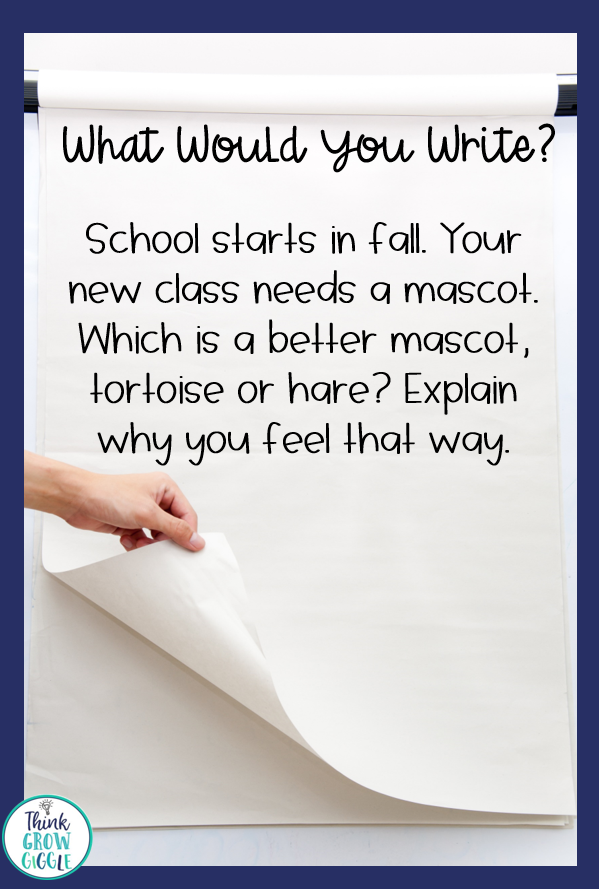
2- WWYW? What Would You Write? 

writing in the upper elementary classroom Analyzing and discussing ideas for given prompts are a fun way to start or end writing periods or to fill in small pockets of time throughout the day. For this activity, you can use writing prompts or picture prompts. Display them on the smart board or chart paper and simply ask, What would you write? Discussions develop from that one simple question. Be sure to model how you want students to respond the first few times you complete this. Discuss together who or what the prompt will be about, the main focus of the writing and what would be included in the beginning, middle and end of the writing. This is a great activity to do in partnerships or small groups, too!

Why I love it: This activity is a great way to model and practice how to brainstorm ideas before writing. 

3-Author’s Craft Round Up

This activity is a great way to practice and revisit writing strategies and techniques that you have taught throughout the year. After presenting a prompt to the students have them brainstorm and share different author’s craft sentences that they might include in that writing piece. For example, if the prompt is about an outdoor adventure students would write a sentence with a smile that describes the weather. This is a fun activity to have students complete with partners, as students are always eager to share their writing. The more you can share the better. Young writers always benefit from models and examples of good writing! Grab a FREE graphic organizer for this activity at the bottom of this post!  
Why I love it: This activity is a great way to review important writing techniques from different writing units without having to write a whole writing piece.

4-Hop on the Writing Carousel 

writing prompt test prep
Carousel activities are always a class favorite! It does take some time to set up the activity, but it is well worth it. This is an activity that I have my students complete in groups of two or three. I hang up one piece of chart paper for each grouping. Each piece of chart paper has a prompt attached with one specific direction. Directions might include, write a story beginning, write a conclusion, write a descriptive sentence, all related to the prompt that is attached to the chart paper. You can have each chart paper have the same directions with different prompts or different directions with the same prompt. Each group of students is given a different color marker to complete the activity on the chart paper. After a few minutes at the chart paper, have students rotate with their marker and begin the next chart paper activity. The catch is that students must reread all the writing already on the chart paper and cannot use any ideas already used. Sharing these completed chart paper assignments at the end of the class period is so important. It allows students to read and discuss all the different ways to respond to the same set of prompts and directions. You can leave some of these chart paper writing assignments hanging up in your classroom as writing anchor charts, too! Read more detailed step by step directions to implementing a writing carousel HERE.
Why I love it: Students are up and out of their seats and working together to achieve a writing goal.

5-Writing Centers Throughout the Year 

writing prompt test prep Even if you do not use centers on a regular basis, it sure is fun to throw a center or two into your instructional period every once in a while! Writing centers are a great way to hold students accountable for writing and practicing important skills independently.  Centers also give you the freedom to work with small groups to practice and re-teach writing concepts as needed. It is easy to use writing prompts at a writing station. Simply provide appropriate prompts and allow students to select the prompt they would like to write to during center time. I like to use seasonal topics to engage my students. I simply print prompts, fold them up and place them in a bucket. I allow students to read through the prompts and select the one topic that they think they would be the most successful at completing. For a challenge, have students randomly select a topic from the bucket. Then they must write to the one prompt that they selected.  Any prompts you have on hand work well for this activity. Find the seasonal prompts that I use with my students HERE and grab a free sample HERE.
Why I love it: Students are given choices for which prompt topic they want to complete.

6-Annotating Completed Writing Prompts

modeled writing test prep elementary There is nothing more important for young writers to see than completed writing prompts. By reading and annotating completed writing pieces, students can see a whole piece of writing from beginning to end in one sitting. It takes a long time for students to complete their own writing piece fully, so seeing a completed piece is a great model and example to show them what is expected. At the beginning of the year, I model how to annotate a written piece, looking for the beginning, middle, end, introduction, closure, as well as different techniques and strategies depending on the writing genre. As the year progresses, students work together to annotate completed pieces. We play different rounds of “I Can Spy” with prewritten prompts. Students work together to search for writing characteristics found in the given writing piece. Grab a FREE “I Can Spy” organizer to help students find different writing elements found in opinion writing pieces at the bottom of this post. You can make up any directions you want while students annotate completed prompts. You can have them find the introduction and then create a new one, you can have them hunt for similes or metaphors, or you can have them replace words that are used too often. You can create a prewritten prompt by simply completing a writing prompt yourself and sharing it with your students. As students feel more comfortable with their writing, ask for student volunteers to share their own completed writing pieces that they wouldn't mind  you using for a class annotation activity. You can copy their work with their permission or rewrite their pieces on chart paper.  HERE are the already completed graphic organizers and modeled writing prompts to annotate that I use with my students.
writing prompt test prep
Why I love it: Students are exposed to different writing models and are given the opportunity to develop skills to help them collaborate with writing partners.

The next time you hear the words writing prompts, don’t cringe! Take those writing prompts and use them in creative and engaging ways to reinforce and practice strategies that you are teaching during your writing block. It is easy to make writing prompts work for you and support what you are doing in the classroom.

How do you use writing prompts in your classroom?

You might be interested in these writing FREEBIES:

https://www.teacherspayteachers.com/Product/Personal-Narrative-Writing-Activities-2017578             https://www.teacherspayteachers.com/Product/Student-Writing-Collaboration-Chart-3684503


You might be interested in these writing BULLETIN BOARD and more sets:


Writing Process Posters and Clip Chart


signature
Back to Top