Showing posts with label Summarizing. Show all posts

Strategies for Teaching Nonfiction Summary Writing

 Summarizing Tips for 3rd, 4th, 5th graders


One sign of strong comprehension skills in students is the ability to summarize what was read using their own words.  This reading comprehension strategy is one of the hardest to teach students, especially when it comes to nonfiction summaries. Often times students want to just write fact after fact after fact and call it a summary. While paying attention to facts found in nonfiction text is important, it is not the basis for writing nonfiction summaries.

Grab the FREE nonfiction summary resources below. Then read the tips below to help you successfully teach your students how to summarize any nonfiction passage, book, or article they read.


Before jumping into summarizing nonfiction there are a few lessons that I teach prior to writing nonfiction summaries. Read on to see how I teach nonfiction summarizing in my classroom, breaking it down into different lessons that help students understand how to summarize informational text.

1. Distinguish Interesting VS. Important
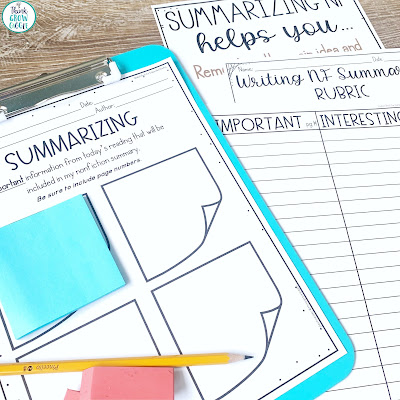

summary writing graphic organizers


Interesting VS Important lessons truly help students avoid writing just a list of facts and calling it a summary.

My students always benefit from lessons on distinguishing the difference between interesting and important information. This is critical when they are writing nonfiction summaries


Begin by simply discussing the difference between what makes something interesting in the books that they read and what makes something important.


Here is how I explain the difference:

Interesting: Something new that I did not know that piqued my curiosity. 

Important: Something that I read that supports the main idea of the reading.


I go one step further to call students' attention to the N in interesting. That helps us remember that interesting is usually something New to us.  Looking at the word important, I call attention to the M. That reminds us that it supports the Main idea. This simple trick makes a huge impact on students' understanding of interesting and important.


A great book to use for a lesson on determining importance is Henry’s Freedom Box by Ellen Levine.  As we read, we chart information into an Interesting vs Important Tchart. This book and activity helps students distinguish the difference, and improve their summary writing as they focus on only the important information.


2. Connect Summarizing with Main Idea...Start with Oral Summaries
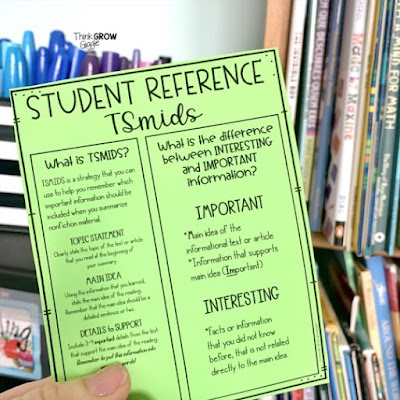

summarizing nonfiction anchor chart tips


The best way for students to understand what to summarize when it comes to nonfiction texts is to connect it to their understanding of finding the main idea.  We begin discussing summarizing by simply practicing oral summaries. Since we have already had several lessons on main idea and supporting detail it is an easy way for students to pull out the important parts of the informational text to include in their oral summary.


When teaching fiction summary writing, one strategy that I use is the SWBSA frame. You can read about that HERE. Since my students love this frame and strategy I wanted to offer them a similar frame and strategy for nonfiction summary writing. That is why I came up with the idea and organizer for a concept I call TSMIDS.

TSMIDS simply stands for topic sentence, main idea, and details that support.


I use this frame to show students how to write a quick summary. This is a good format to use when students are discussing sections of a nonfiction book or article. This is also perfect for students to summarize what is going on within their book when you meet with them for reader’s workshop group time and conferencing. Once students master this format, I expect them to add more to their summaries.


3. Model Summary Writing with Mentor Texts
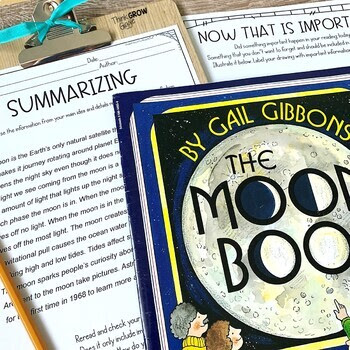
summarizing nonfiction with mentor texts


When introducing summaries, I like to use informational books or articles that we previously read. I model summary writing with a book that we have already read in class or even informational magazines like Time for Kids. Since we read the Moon Book during our science unit it is a great one for us to revisit as readers who are writing summaries.

Teacher tip: Be sure to grab the free resources above to grab the modeled example for a nonfiction summary using the Moon Book.


Once I have modeled my expectations, we write a few nonfiction summaries together, again using books that we have already read as a class. I like to use books and articles that we have already read because I know students already understand the main idea in the books that we have read and discussed as a class. This allows them to focus on writing a summary with important information, rather than reading the book for understanding.


Informational texts and authors that I like to use that have been previously read include:


Just go to your bookshelf and find an informational book that you have already read with the class and start from there! Even better if it is a book that you read during a science, health, or social studies lesson.


4. Practice, Practice, Practice

summarizing nonfiction activities for independent reading


Now that you have taught students everything from determining importance to the TSMIDS strategy, students are ready to head off and practice summarizing nonfiction texts.

The key here is to have them practice, practice, practice. You can have them practice in isolation by using task cards and short passages. Another great way to practice is to have students summarize each section under one heading within a nonfiction passage.

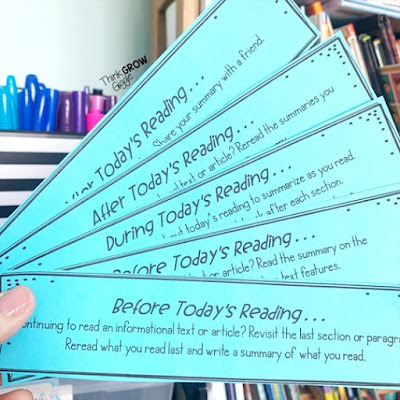
An engaging way that I like to have students practice summaries of informational text is to use my mid-workshop break. When our break comes, I have students meet up with their reading partners and share an oral summary of what was read. Remember that students should practice BOTH summarizing orally and summarizing in writing. The more they share summaries in oral form, the better their written summaries will be.


Summarizing nonfiction does not have to be difficult for you to teach or for your students to grasp. The more specific your instruction is the easier it will be for students to summarize. Once they get the hang of it, don't stop. Have them practice, practice, and practice some more!


You might be interested in reading:

Looking for more reading activities that will make a big impact in your classroom? Click the HERE.

how to make inferences anchor chart for yapper elementary


                    LOVE these tips? Pin to save!

Strategies for Teaching Nonfiction Summary Writing


*affiliate links: “Think Grow Giggle is a participant in the Amazon Services LLC Associates Program, an affiliate advertising program designed to provide a means for sites to earn advertising fees by advertising and linking to Amazon.” (source: Section 5)


signature

4 Quick Tips to Effectively Differentiate Summarizing Instruction

summary mini lessons upper elementary

Teaching students how to summarize is no easy task! 

It is often the most difficult of all the reading strategies for students to grasp. 

The concept of gathering all of the important information from the reading and recapping it in a short, yet informative paragraph is a challenge for most upper elementary students. While introducing the concept of summaries to students can be taught in a whole group setting, to truly help students master the skill of summarizing differentiated instruction is a must! By doing so, students will not only understand how to summarize, but the why summarize, too. 

When students summarize a text as they read they are able to:

  • Remember the most important parts of a text.
  • Carry important information from one chapter to the next.
  • Talk about the important parts of the book with other readers.

When readers summarize, they grow. 

They begin to enjoy discussing what they are reading, and not just with the teacher, but with their peers, too. Conversations about reading begin to take place throughout the day, all thanks to the students' ability to summarize. 

These tips for differentiating summarizing instruction are not only easy to implement, but are highly effective. After you have introduced the concept of summarizing with your students, try these activities during your small group instruction. (Grab free summarizing teaching points at the bottom of this post.)

Teach With Modeled Writing

4 Quick Tips to Effectively Differentiate Summarizing InstructionI love using modeled writing in the classroom! It provides students with visual examples of what is expected. To do this, take a few minutes to write summaries of the books that you have previously read in class before you meet with a small group. You can type the summaries and provide students with their own copies, or you can write the summaries on chart paper and display in the classroom. When students have a model of what is expected, it helps them begin to write summaries correctly. The key in using modeled summary writing is to dissect the written model with students. This shows them each important component included in the summary paragraph. Highlight the parts that you included in the summary that you want students to also include in their own summaries: character names, specific problem, event, and solution, and the use of your own words to write it. I love using the book, The Curious Garden*, written by Peter Brown for summary writing and many other reading strategies, too, like making predictions, questioning, and visualizing. It is perfect to use for modeled summary writing.

Teacher Tip: Save or copy your students' summary writing this year to use in future years as modeled writing!


Scaffold with Graphic Organizers

summarizing teaching ideas and lesson upper elementaryScaffolding with a wide variety of summary graphic organizers is a great way to have all students writing summaries at the same time, but with different levels of support. To challenge students, provide them with a basic T-chart to record important and interesting information from their reading. At the end of the reading period, students will take the important information and write a summary. This type of organizer provides very little support and requires critical thinking from students. Alternatively, to support struggling readers graphic organizers with sentence starters, fill in the blanks, and checklists are more appropriate. Using the SWBST frame is a great way to help students to remember the key story elements needed when writing summaries. Use this frame to guide struggling readers to write the perfect summary. As they write more summaries, they will need this support less and less.

Somebody- Who is the main character?
Wanted-What did the main character want?
But-What problem did the main character face?
So-What events happened to try to solve the problem?
Then-How was the problem solved?

When using graphic organizers to scaffold summary writing support, be sure to move students through different organizers until they can write a summary using their own words and including important information from their reading.


Task Cards Activities 

Task cards with short text is a great way to squeeze in a lot of summarizing practice in a quick and controlled setting. When students are all reading different material, it can be a challenge to assess their summary writing. By using typed text or task card text you know exactly what the students have read, allowing you to assess their summaries with accuracy. Here are my favorite ways to use task cards to differentiate summary writing instruction:

differentiated summarizing task card activity
  • SWBST - Have students read the short story on the task card and use the SWBST frame to write a summary. Short text is perfect for this using and practicing this frame!
  • Do They Match? - Make multiple copies of task cards or typed text. Have different groups of students read and write summaries for the same task cards. Have groups of students meet together and see if their summaries include the same important information, discussing why or why not.
  • Model Match Up -  To support struggling readers, use task card short stories and modeled summaries and have them match together the story and its coordinating summary. This can also be turned into a game of concentration. Don't forget to have students explain why the summary matches the short story and is correctly written.


Use Leveled Reading Materials

After different practice opportunities it is time to send students off to read their independent reading books to summarize as they read. One of the best and simplest ways to differentiate summary writing instruction is to make sure that students are reading just right books. When the level of the book is just right, students' summary writing will become naturally differentiated. Make sure students have read their independent reading book for at least 20 minutes before they attempt to write a summary. This will ensure they have read enough material to write a summary. It is critical to make sure students are in just right books, as students who are reading more complex chapter books are required to hold on to important information as they read and to differentiate important and interesting information. Students who are reading simpler chapter books will have less to hold on to and summarize. By reading the right leveled book, students will be able to appropriate summaries. Encourage students to take notes as they read to make their summary writing easier.

Teacher Tip: Have students summarize their reading each day. At the end of the week have students reflect on the summaries they have written and ask themselves:

  1. Do my summaries reflect what happened in the book?
  2. When I read the summaries all together, does it summarize the entire book? 

These simple questions help students to self-reflect on their own summary writing and focus on ways they can improve as they continue reading and summarizing.

Teaching students to summarize effectively right from the beginning of the school year is critical to helping them grow as readers. The more practice students have with summarizing, both orally and in written form, the better they will be at it. It will also help to make your reading conferences run smoothly, too! What is your best summary writing tip?


Love these ideas? Pin for later!


summary lesson upper elementary


*affiliate links: “Think Grow Giggle is a participant in the Amazon Services LLC Associates Program, an affiliate advertising program designed to provide a means for sites to earn advertising fees by advertising and linking to Amazon.” (source: Section 5)


signature

4 Summarizing Tips Upper Elementary

teaching summary writing activities


If you are an elementary teacher then you understand the struggle that comes with teaching students how to summarize and how to differentiate summarizing instruction.

The concept of summarizing is one of the trickiest for students to grasp. 

Recap the whole book or chapter, but make it brief? Insert confused student faces here! While there are different strategies to teach students how to summarize, I have found that the best way to drive home the concept of summarizing is to start with teaching students what they should NOT do when summarizing. The number one thing students should NOT do when summarizing is to retell what they have read and usually, this is what they do initially!

By beginning summary writing instruction by showing students a retell, you can easily explain the difference between the two. In the primary grades, students are always asked to retell a story. Retelling is something that students know how to do, making it the perfect way to grab their attention when teaching how to summarize. It also allows students to easily make connections within their own learning. The students can self-monitor their summary writing, by asking if what they wrote is a summary or a retelling. 

Read on to find out how I begin tackling the concept of summary writing with my students. 


1. Select a Book to Summarize What Was Previously Read Aloud

teaching summary writing activities

By the time I begin summarizing instruction, we have already read many different picture books. Before the lesson begins, I pull out a few of the class' favorite previously read picture books and display them. I also write a retell and summary for one of the books before the lesson begins, so that the students will have modeled writing to compare summaries and retells when the lesson gets started. Using previously read books is a great way to teach summarizing, since it allows the students to focus on the skill of summarizing, instead of trying to comprehend the story for the first time. (Read more about using previously read books during reading here.)


2. Create an Anchor Chart

teaching summary writing activities
I prepare an anchor chart ahead of time to complete with the students during the initiation of the lesson. A simple SUMMARY vs RETELL t-chart always does the trick. Then I enlist students to tell help me fill it in by telling me what they already know about both summarizing and retelling. Their ideas are discussed and recorded. Using the completed T-chart we begin our discussions on the differences between summarizing and retelling. 


3. Use Modeled Writing

I love to use modeled writing in the classroom for teaching just about everything! After we discuss our summary vs. retell T-chart, I share with the students the retell that I prepared ahead of time, of  one of the previously read books that I have displayed. Students can immediately pick the book that is being retold because it includes all the details of the story.  At this point, I enlist help from the students to cross off some less relevant details from my retelling that would not make it into a summary of the same book. Then I unveil the pre-written summary. Presto! The summary looks like the retell without the unnecessary details. This part of the lessons helps students to understand not just the difference between summarizing and retelling but also illustrates to them that they already have the skills to write summaries!

Need a summary model writing example? Try this one!


4. Practice, Practice, Practice

After analyzing the modeled writing, students are able to grasp the difference between summaries and retells. Now is the time that we practice. I send small groups of students off to write summaries of different previously read picture books, but only give them an index card to write their summaries on. This reminds the students that summaries include only the critical information from the book and are brief. When students are done, we come back together as a class and begin to share. We use our class created T-chart of summaries vs. retell to help us decide if students have written brief summaries or story retells. Students are also able to evaluate if the summaries that students share included important information since they have all heard the stories that students wrote summaries about. 

Head HERE for more summarizing practice activities!

Moving Forward

teaching summary writing activities 4th grade
Summarizing Organizers
This lesson is a great way to introduce summaries in your classroom, but it is only the beginning. This lesson provides the students with background knowledge to help them understand the structure of summaries and provides an anchor chart visual of what to do, and what NOT to do when writing summaries. At this point, student summary writing skills are just developing, so they need to be honed and sharpened throughout the year. (Yes, this is a year-long process!)  There are many different strategies to help students perfect their summary writing skills. My favorites include: 
  • The 5 Ws-Students answer the 5W questions about the book that they are reading to help them write their summary. Who? What? When? Where? Why?
  • SWBSA-This strategy works well when reading books with strong characters. This stands for somebody, wanted, but, so, and. Once the students complete an SWBSA organizer they can easily write a summary.
  • Story Map Summaries-Students complete a story map after their reading. Using the completed story map, students then write a summary. 
If you are finding that your students are struggling with including important information in their summaries, try teaching a lesson on interesting vs important information. Create a class t-chart to help students understand the difference between the two. 


Summarizing is one of the most difficult concepts to teach and requires many follow up mini-lessons to help students succeed. Reading passages and task card practice for repetitive practice does help! Students must be given many opportunities to practice writing summaries, so do not expect them to become experts right away. Hold your students accountable for summary writing at least once a week. The more that students practice the better they will become. Students should also be sharing summaries orally each day. This can be done while you confer with them one-on-one or during reading partnership time. 


Remember the more times a student can practice summarizing, the better that they will become! Read about strategies for teaching other reading concepts like questioning, HERE.(Grab free summarizing teaching points to guide your follow up lessons below.)


Head to my TPT shop for these resources you might be interested in:


signature
Back to Top